Daftar Isi Show
| Characteristics | Details |
|---|---|
| Genus | Limnophila |
| Species | Limnophila sp. ‘Vietnam’ |
| Family | Plantaginaceae |
| Origin | Vietnam, Southeast Asia |
| Common Name | Limnophila mini ‘Vietnam’ |
| Lighting Requirements | High (±90–150 µmol m⁻² s⁻¹ / PAR) |
| Optimal Temperature | 22–27 °C |
| Growth Rate | Fast |
| Placement | Foreground to Midground |
| Plant Height | 5–15 cm |
| Ideal pH | 4.5–7.0 |
| Water Hardness | GH 3–10 dGH; KH 1–6 dKH |
| CO₂ Requirement | High |
| Propagation | Stem cuttings and natural runners |
Additional Information
Limnophila sp. ‘Vietnam’ is a compact stem plant variant within the Limnophila genus that exhibits distinct morphological adaptations compared to more common species such as Limnophila sessiliflora or Limnophila aromatica. Its taxonomic status remains at the undescribed species level (sp.), indicating that it has not yet been formally classified in scientific literature, despite being widely recognized in the aquascaping trade.
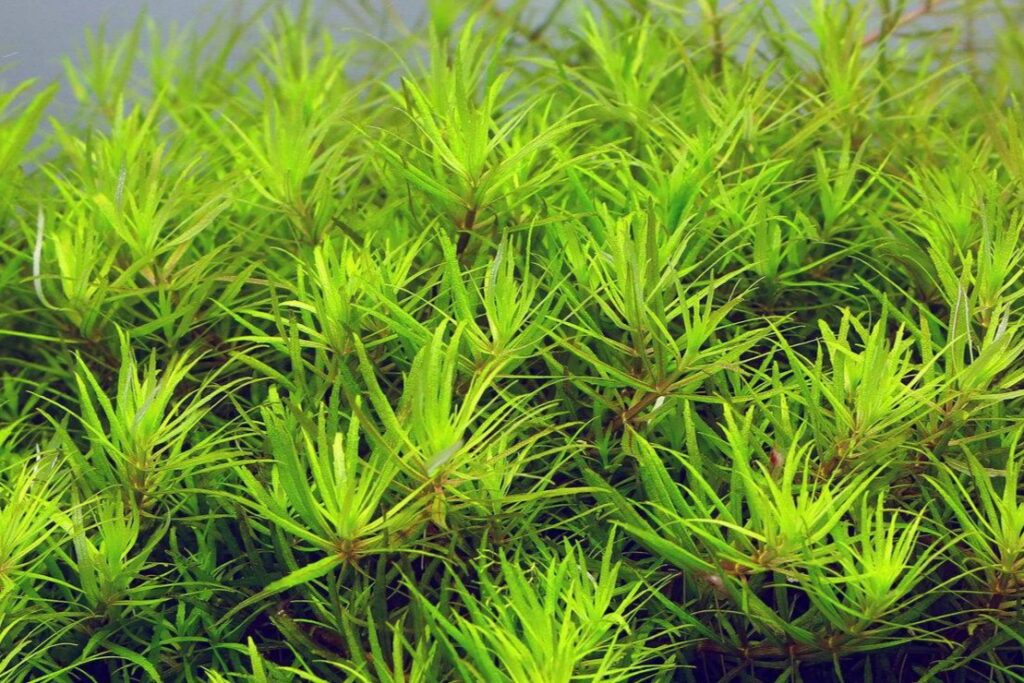
Morphologically, this plant features a whorled leaf arrangement, typically consisting of five to seven leaves per node. The leaves are linear to lanceolate in shape and relatively small, creating a fine, dense texture. This structural characteristic produces a compact, bush-like appearance with a consistent star-shaped formation, particularly under high light conditions.
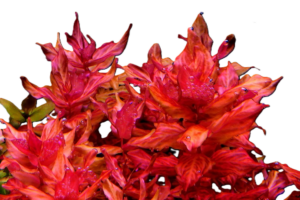
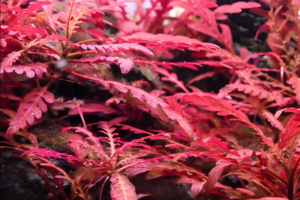
The base coloration is bright green. Under high light intensity and adequate micronutrient availability—especially iron—the stems and leaf midribs may develop subtle brownish-red to purplish hues. This pigmentation response is associated with anthocyanin accumulation as a protective mechanism against strong light exposure.
Its natural habitat is found in tropical regions of Vietnam, particularly in marshes and shallow water systems subject to seasonal water level fluctuations. These environments are typically characterized by high light exposure, nutrient-rich substrates, and relatively soft, slightly acidic water. Such conditions are directly reflected in its physiological requirements in aquarium settings.
In aquascaping, Limnophila sp. ‘Vietnam’ is commonly used as a foreground to midground plant. Under high lighting, it can form low, carpet-like growth with a bushy texture, making it effective as a transitional element between foreground and background zones. Its dense structure also provides microhabitats for small aquatic fauna such as ornamental shrimp.
Requirements and Care
Growth Characteristics
Limnophila sp. ‘Vietnam’ exhibits highly plastic growth behavior, strongly influenced by light gradients. Under high and evenly distributed lighting reaching the substrate, the plant tends to grow horizontally, producing lateral runners. Each node in contact with the substrate can develop roots, forming dense colonies.
In contrast, under suboptimal lighting or shading conditions, the plant shifts to vertical growth with elongated internodes. This results in reduced visual density and typically requires regular trimming to maintain a compact form.
Its growth rate is fast, making biomass control essential to maintain proper water circulation and effective CO₂ distribution, particularly in lower layers.
Lighting
This plant belongs to the high light category, requiring PAR levels of approximately ±90–150 µmol m⁻² s⁻¹. Within this range, it maintains compact growth, short internodes, and dense apical structures.
Below this threshold, the plant tends to exhibit etiolation, characterized by elongated stems and increased spacing between nodes. Coloration remains predominantly green with minimal pigment development.
Light spectrum also plays a role in coloration, where red and blue wavelengths contribute to enhanced reddish pigmentation in plant tissues.
CO₂ and Carbon
Limnophila sp. ‘Vietnam’ has a high CO₂ requirement. While it may survive without CO₂ injection under certain conditions, growth becomes significantly slower and less compact.
In high-tech systems with stable CO₂ supply at optimal levels, the plant responds with accelerated growth and more aggressive runner production. CO₂ stability is critical, as fluctuations can induce plant stress and increase the risk of algae development, particularly on fine leaf structures.
Nutrients
The plant requires sufficient macronutrients such as nitrogen, phosphorus, and potassium to sustain its fast growth. Micronutrients, especially iron, play a crucial role in maintaining coloration and healthy shoot development.
Nutrient balance is essential. Imbalances, particularly between nitrogen and phosphorus, can affect morphology and limit optimal color expression. Due to its rapid growth rate, consistent nutrient availability is more effective than large, infrequent dosing.
Water Parameters
This species prefers slightly acidic to neutral water, with an ideal pH range of 4.5–7.0. In such conditions, micronutrient availability is generally higher and more accessible for plant uptake.
The optimal temperature range is 22–27 °C, supporting stable metabolic activity without increasing stress risk. Water hardness should be kept at low to moderate levels, with GH 3–10 dGH and KH 1–6 dKH.
Parameter stability is more critical than achieving exact numerical values, as significant fluctuations can negatively impact growth consistency and plant health.
Substrate
An active substrate with high cation exchange capacity is recommended to support nutrient uptake through the root system. Fine-grained substrates facilitate root penetration and promote the formation of dense colonies.
Given its tendency to form compact growth, substrate porosity must be sufficient to prevent anaerobic conditions in the lower layers. Accumulated detritus should be managed to maintain root health.
Propagation
Propagation is efficiently achieved through stem cuttings by trimming healthy tops and replanting them into the substrate. New roots typically develop from nodes within a short period.
Additionally, the plant naturally produces runners that spread across the substrate. These runners can be separated and replanted once they have developed sufficient root systems, allowing efficient coverage of larger areas.
Conclusion
Limnophila sp. ‘Vietnam’ is a compact aquascape plant with fine texture, suitable for foreground to midground placement. Its ability to grow horizontally under high lighting makes it highly effective for creating dense, detailed plant coverage.
This species performs best in high-tech systems with strong lighting, stable CO₂ supply, and balanced nutrition. Under suboptimal conditions, it can survive but with reduced visual quality and density.
From both aesthetic and functional perspectives, Limnophila sp. ‘Vietnam’ offers significant flexibility in aquascape design, serving as a transitional element or ground cover while also contributing as a microhabitat for small aquatic organisms.