Daftar Isi Show
| Parameter | Detail |
|---|---|
| Genus | Limnophila |
| Species | sp. Belem (a variety of L. aromatica) |
| Family | Plantaginaceae |
| Origin | Tropical Asia (not Brazil) |
| Common Name | Belem Marshweed |
| Lighting Requirement | High (±90–150 µmol m⁻² s⁻¹ / PAR) |
| Optimal Temperature | 22–27 °C |
| Growth Rate | Fast |
| Placement | Midground to Background |
| Plant Height | 5–30 cm |
| Ideal pH | 5.5–7.5 |
| Water Hardness | GH 3–10 dGH; KH 1–6 dKH |
| CO₂ Requirement | High |
| Propagation | Stem cuttings |
Additional Information
Limnophila sp. Belem is a botanical subject that frequently triggers technical discussion among professional aquascapers due to the discrepancy between its trade name and its scientific identity. Taxonomically, the use of this name represents a provisional nomenclature, indicating a species that had not yet been formally described at the time of its introduction into the aquatic plant trade. However, morphological analysis of reproductive organs and vegetative structures strongly suggests that this plant is, in fact, a distinct variety of Limnophila aromatica.
The designation “Belem” is a geographical misnomer referring to a region in Brazil, whereas the genus Limnophila is naturally distributed only across Asia, Africa, and Australia.
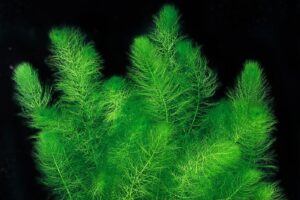
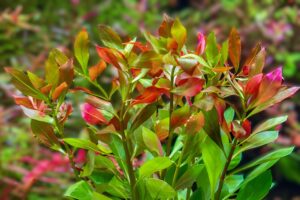
Visually, Limnophila sp. Belem exhibits highly distinctive phenotypic traits compared to other aromatica varieties. Its narrow lanceolate leaves are arranged in whorls at each node, typically consisting of two to three leaves under submerged conditions. The leaf margins are sharply serrated, contributing a complex texture to aquascape compositions.
The plant’s defining feature lies in its anthocyanin pigmentation pattern, which appears as irregular reddish-purple patches across the leaf surface, making it a dramatic focal element within an aquascape layout.
Requirements and Care
Maintaining Limnophila sp. Belem requires strict environmental parameter management to preserve physiological stability. Failure to maintain chemical homeostasis in the water column can induce cellular stress, leading to stem degeneration or mass leaf shedding.
Growth Characteristics
This plant demonstrates strong apical dominance with a very rapid stem elongation rate under optimal conditions. Its growth pattern is primarily vertical toward the light source, but it exhibits sufficient plasticity to develop dense lateral branching when regularly trimmed.
Its high metabolic rate makes Limnophila sp. Belem an efficient nutrient assimilator within the water column, thereby helping to mitigate the risk of algal outbreaks.
Lighting
The lighting requirement falls within a high-intensity spectrum to trigger photoprotective mechanisms responsible for producing its intense purple coloration. The recommended PAR range is approximately 90–150 µmol m⁻² s⁻¹ at the planting zone.
Insufficient light intensity leads to etiolation, where internodal spacing becomes excessively elongated and the purple pigmentation fades into pale green. A light spectrum rich in red and blue wavelengths is strongly recommended to maximize anthocyanin synthesis.
CO₂ and Carbon
Artificial CO₂ injection is an essential prerequisite for achieving optimal growth performance. A stable CO₂ concentration in the range of 20–30 mg/L is critical to support photosynthetic efficiency.
Without adequate carbon supply, the plant exhibits reduced leaf density and diminished recovery capacity after trimming.
Nutrition
As a fast-growing species with exponential growth potential, Limnophila sp. Belem requires continuous availability of both macro- and micronutrients. Iron (Fe) plays a crucial role in the development of its violet-purple coloration.
Micronutrient deficiencies often manifest as chlorosis at the growth tips, where new shoots appear pale yellow or even white due to impaired chlorophyll and accessory pigment synthesis.
Water Parameters
Stability in water parameters is essential for long-term success. The ideal temperature range is 22–27 °C, as temperatures above this threshold accelerate respiration excessively.
This plant prefers soft to moderately hard water conditions, with a pH range of 5.5–7.5, general hardness of 3–10 dGH, and carbonate hardness of 1–6 dKH. Lower KH levels facilitate CO₂ dissociation, making it more readily available for plant uptake.
Substrate
The root system of Limnophila sp. Belem actively absorbs nutrients from the substrate. The use of aquasoil with high cation exchange capacity (CEC) is strongly recommended to ensure mineral availability in the root zone.
A substrate layer of at least 5 cm provides sufficient space for optimal root development and structural support for its tall stems.
Propagation
The most efficient propagation method is through stem cuttings. Aquascapers can trim the apical portion of the plant and replant it into the substrate, while the remaining lower stem will stimulate new lateral shoots from the nearest nodes.
This technique also serves to rejuvenate plant density and prevent lower stem sections from becoming bare due to shading.
Conclusion
Limnophila sp. Belem is a highly valuable specimen in aquascaping due to its unique combination of serrated leaf structure and intense violet-purple coloration. Although botanically a variety of Limnophila aromatica, the “Belem” identity remains relevant as a strong visual differentiator among background plants.
Successful cultivation depends heavily on high light intensity and stable CO₂ and nutrient supply. With proper trimming management, this plant contributes significant aesthetic value while also functioning as a biological stabilizer within complex aquatic ecosystems.