Daftar Isi Show
| Characteristics | Detail |
|---|---|
| Genus | Hygrophila |
| Species | corymbosa |
| Family | Acanthaceae |
| Origin | Southeast Asia |
| Common Name | Willow Hygro |
| Light Requirement | Medium–high (±80–150 µmol m⁻² s⁻¹ / PAR) |
| Optimal Temperature | 24–28 °C |
| Growth Rate | Fast |
| Placement | Midground / Background |
| Plant Height | ±30–60 cm |
| Ideal pH | 6.0–7.5 |
| Water Hardness | GH 6–20 dGH; KH 2–12 dKH |
| CO₂ Requirement | Adaptive |
| Propagation | Stem cuttings |
Additional Information
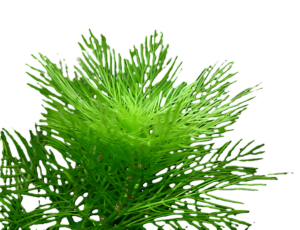
Hygrophila corymbosa ‘angustifolia’ is a stem plant variety characterized by narrow, lance-shaped leaves arranged oppositely along an upright stem. The stem structure is relatively sturdy, with internodes that can elongate depending on light intensity. Submersed leaves tend to be longer and more flexible, while in emersed conditions the leaves become shorter and thicker.
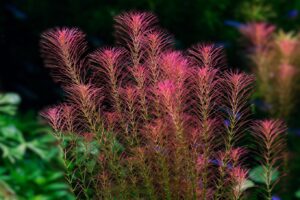
Visually in aquascaping, this plant introduces a fine texture with linear leaf shapes that contrast well against broad-leaf plants. Its base color is bright green, which can shift to darker green, slightly brownish, or even reddish tones under high light and sufficient nutrients. This characteristic makes it effective as a transition element between midground and background.
Its natural habitat is in shallow waters of Southeast Asia, such as riverbanks, swamps, and seasonally flooded areas. Its adaptation to fluctuating water conditions makes it relatively tolerant in various aquascape setups.
In layouts, Hygrophila corymbosa ‘angustifolia’ is commonly used as a background or mid-background plant. Its vertical growth helps build visual structure while also functioning as an efficient nutrient absorber within the aquarium system.
Requirements and Care
Growth Characteristics
This plant is a stem species with a vertical growth pattern. The main stem continues to grow upward, while lateral shoots readily form after trimming. Its response to pruning is excellent, producing denser branching and forming compact clusters.
Under optimal conditions, the growth rate is fast. The plant also shows direct responses to environmental factors, particularly light and nutrients, which are reflected in leaf size and internode spacing.
Lighting
The lighting requirement falls within medium to high levels, ranging approximately ±80–150 µmol m⁻² s⁻¹. Under sufficient light intensity, growth becomes more compact, leaves are denser, and coloration tends to be more intense.
Under low light conditions, the plant can still survive but will exhibit stem elongation (longer internodes), smaller leaves, and a less dense overall structure. Conversely, higher lighting encourages more horizontal growth at the tips and increases overall plant density.
CO₂ and Carbon
CO₂ requirements are adaptive. Hygrophila corymbosa ‘angustifolia’ can grow without CO₂ injection in low-tech systems by utilizing naturally dissolved carbon.
However, in systems with CO₂ injection, growth becomes significantly faster and more stable, with larger leaves and more intense branching. Consistent carbon availability also helps maintain a compact form under high lighting conditions.
Nutrients
As a fast-growing plant, its nutrient demand is relatively high. Nutrient uptake occurs efficiently through both the water column and the root system.
A balanced supply of macronutrients such as nitrogen, phosphorus, and potassium is essential to maintain stable growth. Nutrient deficiencies are typically visible in older leaves through chlorosis or spotting. Micronutrients, particularly iron, also play an important role in maintaining optimal leaf coloration.
Water Parameters
Hygrophila corymbosa ‘angustifolia’ is quite tolerant of varying water parameters, but stability remains the key factor. The ideal pH range is 6.0–7.5 with an optimal temperature of 24–28 °C.
Water hardness can range from GH 6–20 dGH and KH 2–12 dKH. Its good adaptability to soft to moderately hard water makes it flexible for various aquarium conditions, as long as extreme fluctuations are avoided.
Substrate
A nutrient-rich substrate supports stronger root development and more stable growth. The root system develops well and contributes to additional nutrient uptake from the substrate.
Although it can grow in inert substrates such as sand or gravel, nutrient availability must still be maintained through the water column. Direct planting in substrate remains the most stable method to ensure proper positioning and optimal growth.
Propagation
Propagation is done vegetatively through stem cuttings. The cut top portions can be replanted directly into the substrate and will develop new roots relatively quickly.
The remaining parent stem will produce new lateral shoots, meaning regular trimming not only controls plant height but also increases overall density.
Conclusion
Hygrophila corymbosa ‘angustifolia’ is a flexible stem plant with a combination of fast growth and high adaptability to various conditions. It is suitable for both low-tech and high-tech systems, with optimal performance under medium to high lighting and balanced nutrient supply.
From an aesthetic perspective, its narrow leaves provide an effective textural contrast in midground to background areas. Beyond its visual value, its strong nutrient uptake also contributes to aquarium ecosystem stability. With regular trimming and stable water parameters, this plant can form a dense and well-structured green mass within an aquascape layout.