Daftar Isi Show
| Characteristics | Detail |
|---|---|
| Genus | Hygrophila |
| Species | Hygrophila difformis |
| Family | Acanthaceae |
| Origin | Southeast Asia (India, Bangladesh, South Asia) |
| Common Name | Water wisteria |
| Light Requirement | Medium–high (±80–150 µmol m⁻² s⁻¹ / PAR) |
| Optimal Temperature | 22–28 °C |
| Growth Rate | Fast |
| Placement | Midground – Background |
| Plant Height | 20–50 cm |
| Ideal pH | 6.0–7.5 |
| Water Hardness | GH 3–10 dGH; KH 1–6 dKH |
| CO₂ Requirement | Adaptive |
| Propagation Method | Stem cuttings |
Additional Information
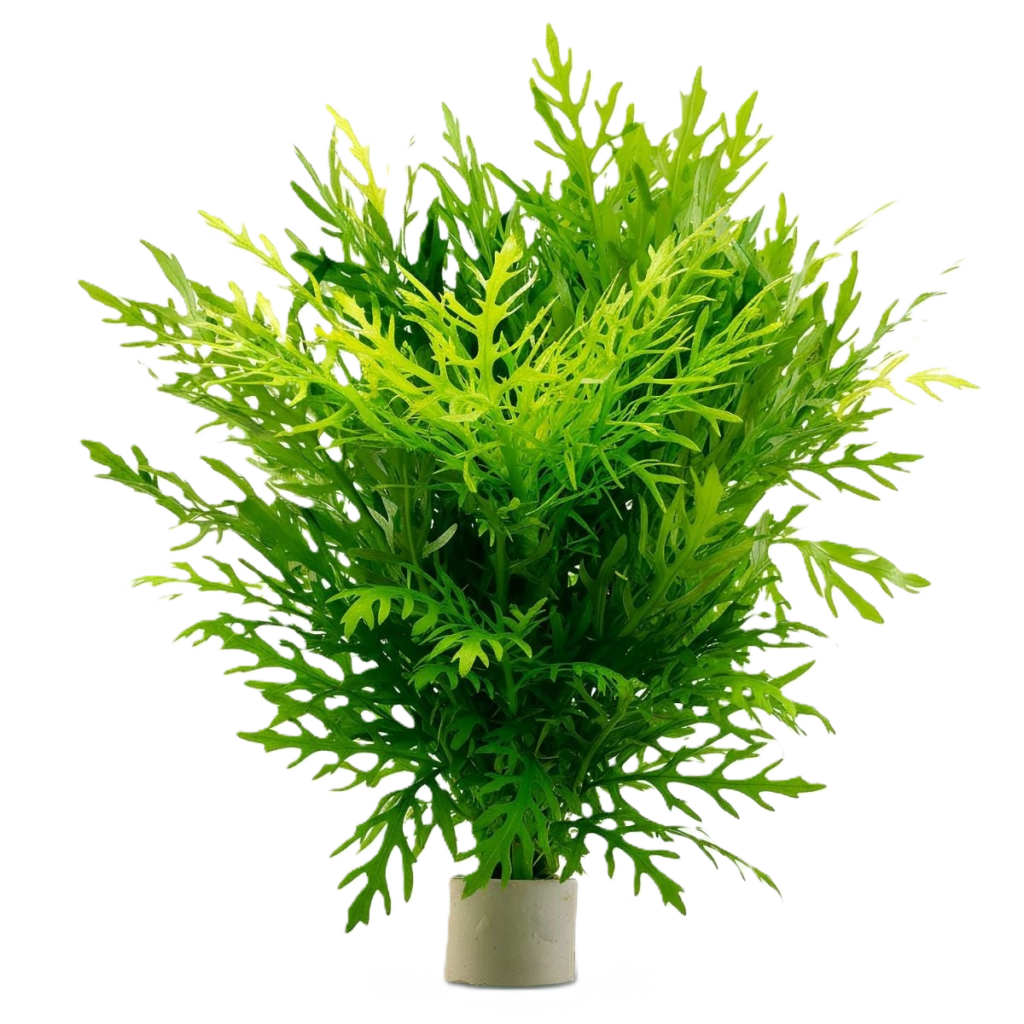
Hygrophila difformis is a widely used aquatic plant recognized for its finely divided, pinnate leaf structure. In emersed growth, the leaves are broader with serrated edges, while in submerged conditions they transform into finely dissected forms (heterophylly) without negatively affecting plant health.
The plant produces upright stems that can branch when trimmed, resulting in a dense and bushy appearance. Native to shallow waters in Southeast Asia, this species naturally grows in environments with variable conditions, contributing to its adaptability in aquariums.
In aquascaping, Hygrophila difformis is commonly used as a midground to background plant due to its rapid growth and ability to quickly fill space. Its dense foliage also plays a functional role in nutrient uptake, helping to stabilize the aquarium environment.
Requirements and Care
Growth Characteristics
This plant grows vertically with elongated stems that extend toward the water surface. It can form dense clusters, especially when regularly trimmed to encourage lateral shoot development.
Under low light conditions, growth tends to be more elongated with less density. Under medium to high light, the plant becomes more compact with fuller foliage. It is highly adaptable and performs well in both low-tech and high-tech systems when basic conditions are met.
Light
The lighting requirement falls within the medium to high category, with a PAR range of approximately 80–150 µmol m⁻² s⁻¹.
Under lower light conditions (below ~80 µmol m⁻² s⁻¹), the plant tends to grow more sparsely with longer internodes. Under higher light intensity, leaf density increases and coloration becomes brighter.
Moderate lighting generally supports stable growth with minimal algae issues when nutrients are balanced, while higher lighting accelerates overall growth rate.
CO₂ and Carbon
Hygrophila difformis is adaptive to CO₂ availability. It can grow well without additional CO₂ injection in low-tech systems, although growth may be slower.
In high-tech systems with CO₂ supplementation, growth becomes significantly faster, and leaf development improves in both size and density. While CO₂ is not essential, consistent availability enhances overall plant performance.
Nutrients
This plant has relatively high nutrient demand due to its fast growth rate. A balanced supply of macronutrients and micronutrients is important for optimal development.
Nitrogen, potassium, and iron are particularly important for maintaining healthy green foliage. Nutrient deficiencies may result in yellowing leaves or reduced growth rate. Stable nutrient availability is more important than excessive dosing.
Water Parameters
The ideal pH range is between 6.0 and 7.5. Recommended water hardness ranges from GH 3–10 dGH and KH 1–6 dKH, reflecting slightly acidic to neutral conditions.
The optimal temperature range is 22–28 °C. Although the plant tolerates a range of conditions, sudden fluctuations should be avoided to maintain consistent growth.
Substrate
Hygrophila difformis does not require a specialized substrate. Its relatively simple root system can anchor in various types of substrate, including gravel or sand.
While nutrient-rich substrates can enhance growth, they are not strictly necessary. The plant can also be floated temporarily, allowing roots to develop before planting. In general, the substrate primarily serves as anchorage, while nutrient uptake largely occurs through the water column.
Propagation
Propagation is easily achieved through stem cuttings. Sections of the stem measuring approximately 8–15 cm with several nodes can be cut and replanted.
Before planting, the lower leaves should be removed to prevent decay. The cuttings should be inserted into the substrate, where they will quickly develop new roots from the nodes. New shoots will emerge shortly after establishment.
This method is simple, reliable, and widely used in aquascaping to increase plant density.
Conclusion
Hygrophila difformis is a highly adaptable aquascape plant with fast growth and relatively simple care requirements. It is suitable for both beginners and experienced aquascapers, performing well in low-tech and high-tech systems alike.
As a midground to background plant, it provides dense, bright green foliage with fine texture, contributing both aesthetic and functional value. With moderate lighting and stable nutrient conditions, this plant can play an important role in maintaining a balanced and visually cohesive aquascape.