Daftar Isi Show
| Characteristic | Details |
|---|---|
| Genus | Limnophila |
| Species | Limnophila rugosa (Roth) Merr. |
| Family | Plantaginaceae |
| Origin | India, Nepal, Southeast Asia, Southern China, to the Pacific Islands |
| Common Names | Basil-leaf Limnophila, Wrinkled Marsh Weed, Ruffled Water Hyssop |
| Lighting Requirements | Medium–high (±70–130 µmol m⁻² s⁻¹ / PAR) |
| Optimal Temperature | 22–28 °C (tolerance 15–30 °C) |
| Growth Rate | Slow to medium |
| Placement | Midground to background |
| Plant Height | 15–50 cm |
| Ideal pH | 4.0–7.5 |
| Water Hardness | Soft to medium (±3–12 dGH; 0–14 dKH) |
| CO₂ Requirement | Medium (20–40 mg/L) |
| Propagation | Stem cuttings and seeds |
Additional Information
Limnophila rugosa is one of the most morphologically distinctive species within the genus Limnophila. From a taxonomic standpoint, this species has undergone significant reclassification. Earlier literature often placed it within the family Scrophulariaceae, but modern molecular phylogenetic studies—utilizing DNA markers such as ITS and trnL-F—have confirmed its placement within the family Plantaginaceae, specifically under the tribe Gratioleae. This revision is important for aquascapers and botanists in understanding its phylogenetic relationship with genera such as Hygrophila and Bacopa, which may appear similar but exhibit different physiological responses in aquatic systems.
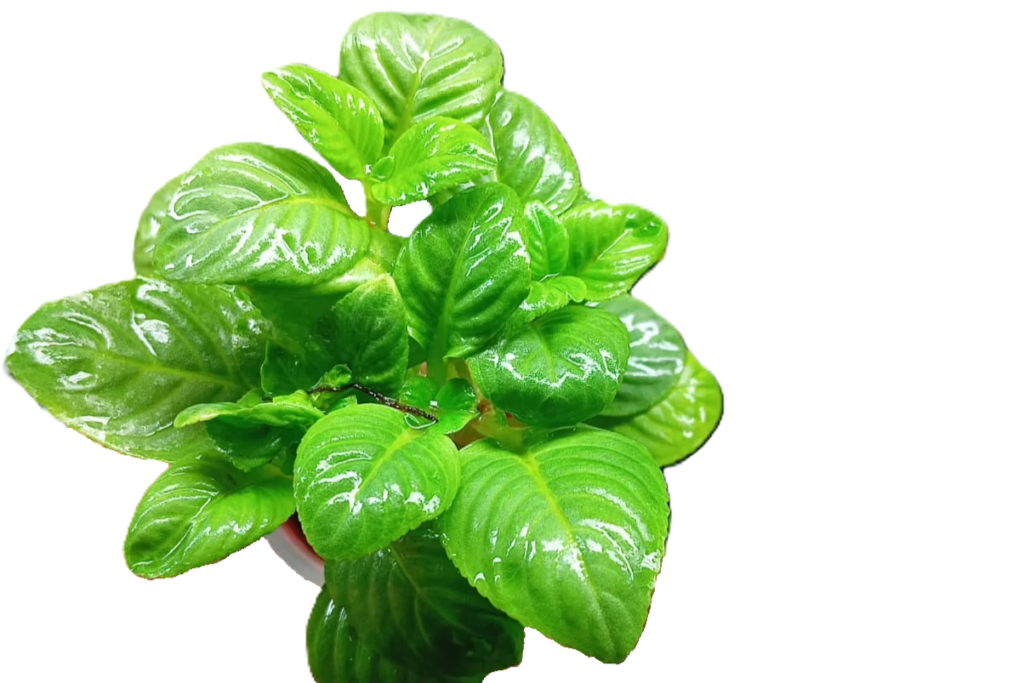
Morphologically, L. rugosa is easily distinguished from other Limnophila species that typically exhibit fine, feathery foliage such as L. sessiliflora. Its leaves are arranged in opposite decussate pairs along the stem, with shapes ranging from ovate-lanceolate to ovate-elliptical. Leaf size varies between 2–12 cm in length and 1–5 cm in width. The most defining feature is the bullate (hammered or wrinkled) leaf surface, giving it a visual resemblance to basil leaves. This texture is not merely aesthetic; ecologically, the uneven surface increases effective surface area for light capture, providing an adaptive advantage in aquatic environments with fluctuating light intensity.
This species demonstrates strong adaptability to both submersed and emersed conditions. In submersed form, the plant displays a bright “parrot green” coloration with slightly softer leaf texture while retaining its characteristic wrinkled pattern. Under emersed conditions, stems become more rigid, occasionally slightly hirsute, and capable of producing small tubular flowers in purple to lavender hues with yellow markings in the throat. The leaves contain essential oils dominated by trans-anethole (±75–76%) and estragole (±21–22%), producing a distinctive anise-like aroma when crushed.
Its geographical distribution spans tropical to subtropical Asia, including India, Bangladesh, Nepal, Bhutan, and Southeast Asian countries such as Indonesia, Malaysia, Thailand, Vietnam, and the Philippines. Natural habitats typically include shallow, slow-moving or stagnant waters such as riverbanks, swamps, ponds, and rice paddies. The species can be found from lowland regions up to elevations of approximately 1,500 meters above sea level, indicating a broad tolerance to environmental variation.
In aquascaping, Limnophila rugosa serves as a strong textural contrast element. Its relatively large, wrinkled leaves create clear visual differentiation when combined with fine-leaved species. It is best positioned in the midground to establish a smooth transition toward the background. This plant is commonly used in Dutch-style aquascapes to form structured “plant streets.” Its moderate growth rate is advantageous for maintenance, as it does not require overly frequent trimming.
Care and Requirements
Growth Characteristics
Limnophila rugosa exhibits a stable vertical growth pattern supported by relatively मजबूत stems capable of bearing its thick foliage without collapsing. Unlike some other Limnophila species that tend to be more fragile, this species maintains structural integrity well. Under optimal conditions, it can reach heights of up to 50 cm, although in aquascaping practice it is typically maintained at 15–30 cm to preserve midground proportions.
Apical dominance is evident, but the plant responds well to pruning through lateral shoot development. After trimming the top հատված, auxin redistribution stimulates the emergence of two to three new shoots from lower nodes. Over time, this results in a dense, bushy structure. The root system develops extensively, allowing efficient nutrient uptake from the substrate.
Lighting
Lighting is a critical factor influencing density and overall morphology. This species falls within the medium to high light category, with an optimal PAR range of approximately 70–130 µmol m⁻² s⁻¹ at substrate level.
Under higher light intensity (>90 µmol m⁻² s⁻¹), leaf growth becomes more compact, the bullate texture becomes more pronounced, and coloration appears brighter. Under low light conditions (<40 µmol m⁻² s⁻¹), the plant tends to exhibit etiolation, characterized by elongated internodes and reduced aesthetic quality. Lower leaf drop is also common due to insufficient light penetration.
Even light distribution is essential to maintain active photosynthesis throughout the entire plant structure.
CO₂ and Carbon
Although relatively adaptable, optimal performance of L. rugosa depends heavily on adequate dissolved carbon availability. CO₂ injection at levels of 20–40 mg/L significantly enhances metabolic activity, improves nutrient uptake efficiency, and strengthens tissue structure.
In non-CO₂ systems, the plant can survive, but growth becomes considerably slower, with smaller leaves and less pronounced texture. Stable CO₂ levels are crucial for maintaining its full visual potential.
Nutrients
As a stem plant with substantial leaf biomass, Limnophila rugosa has moderate to high nutrient demands. Nitrogen, in the form of nitrate (NO₃), at concentrations of 10–25 mg/L is essential to maintain healthy green coloration and prevent chlorosis.
Phosphate (PO₄) supports new tissue development, while potassium (K) is critical in preventing pinholes in leaves. Micronutrients, particularly iron (Fe), play a direct role in chlorophyll synthesis and color intensity.
Nutrient uptake occurs through both leaves and roots, making a balanced supply between the water column and substrate essential.
Water Parameters
The species exhibits relatively broad tolerance but performs best under stable conditions. The ideal pH range lies between 4.0 and 7.5, with a preference for slightly acidic to neutral environments.
Typical technical parameters include:
| Parameter | Ideal Range |
|---|---|
| GH | 3–12 dGH (tolerance up to 30 dGH) |
| KH | 1–6 dKH |
| TDS | 100–250 ppm |
| Temperature | 22–28 °C |
Low to moderate KH supports CO₂ stability and helps prevent significant pH fluctuations during the photoperiod. A stable temperature around 24–25 °C is often considered optimal for balancing photosynthesis and respiration.
Substrate
A nutrient-rich substrate significantly enhances growth performance. Aquasoil with high cation exchange capacity (CEC) improves nutrient retention and availability in the root zone.
A substrate depth of at least 4–6 cm is recommended to support root development. While the plant can grow in inert media such as sand or fine gravel, growth tends to be slower unless supplemented with root-zone nutrients.
Proper substrate oxygenation is also important to prevent anaerobic conditions that may lead to root decay.
Propagation
The most practical propagation method in aquariums is through stem cuttings. The apical portion, approximately 10 cm in length, can be trimmed and replanted after removing leaves from the lower nodes. Under stable conditions, new roots develop quickly, and the cutting establishes as a new plant.
In emersed conditions, the plant can produce flowers and viable seeds. However, in aquascaping practice, vegetative propagation remains the preferred method due to its efficiency and consistency.
Conclusion
Limnophila rugosa is an aquascape plant with strong visual character, primarily defined by its bullate leaf texture and bright green coloration. It functions effectively as a midground element, particularly in Dutch-style layouts where structured plant groupings and textural contrast are emphasized.
While it can adapt to low-tech systems, optimal results are achieved in high-tech setups with medium to high lighting (±70–130 µmol m⁻² s⁻¹), stable CO₂ supply, and nutrient-rich substrate. Its moderate growth rate makes it manageable for long-term maintenance.
With its ease of propagation and role in nutrient uptake, Limnophila rugosa contributes not only to the visual composition but also to the ecological stability of the aquarium system.