Daftar Isi Show
| Characteristic | Detail |
|---|---|
| Genus | Eleocharis |
| Species | Eleocharis pusilla |
| Family | Cyperaceae |
| Origin | East Asia, Southeast Asia, and Australia, particularly shallow tropical to subtropical waters |
| Common Name | Mini Hairgrass, Dwarf Hairgrass Mini |
| Light Requirement | Medium to high (±70–150 µmol m⁻² s⁻¹ / PAR) |
| Optimal Temperature | 20–28 °C |
| Growth Rate | Moderate |
| Placement | Foreground |
| Plant Height | 3–8 cm |
| Ideal pH | 5.5–7.0 |
| Water Hardness | GH ±2–10 dGH; KH ±0–4 dKH |
| CO₂ Requirement | Medium to high |
| Propagation | Lateral stolons (runners) |
Additional Information
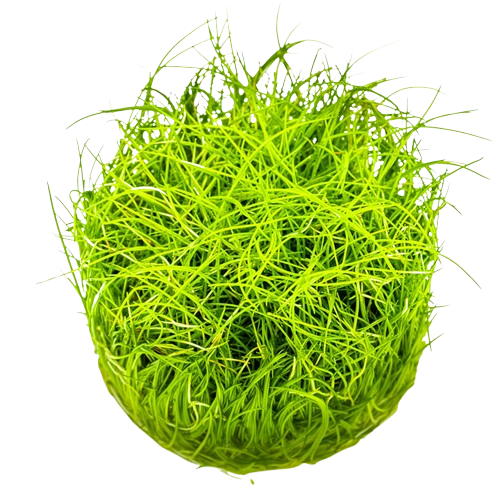
Eleocharis pusilla “Mini” is a fine-leaved aquatic grass characterized by slender, cylindrical blades that grow in compact tufts and spread horizontally through underground stolons. Compared with other commonly cultivated Eleocharis species such as E. acicularis and E. parvula, the “Mini” form remains relatively short and compact, making it particularly suitable as a carpeting plant in small to medium-sized aquariums.
In aquascaping, this plant is primarily used to create a fine-textured foreground carpet resembling a miniature underwater grassland. Its narrow foliage produces a soft visual texture without overwhelming the scale of the layout.
Its natural habitats include shallow freshwater environments with muddy or fine sandy substrates, where horizontal stolons allow the plant to spread laterally and establish dense colonies.
When cultivated under stable aquarium conditions, the same growth strategy allows Eleocharis pusilla “Mini” to gradually cover open substrate and form a relatively uniform foreground.
Care and Requirements
Growth Characteristics
Eleocharis pusilla “Mini” spreads horizontally through stolons that extend through or just beneath the substrate. New shoots develop at intervals along these runners, allowing a single planted portion to gradually establish a larger colony.
Under optimal conditions, the plant can form a dense carpet with relatively consistent height. Growth is strongly influenced by light intensity and carbon availability.
When environmental conditions are suboptimal, foliage tends to become longer and more widely spaced, while lateral stolon production slows. This can result in an open carpet that takes considerably longer to achieve full coverage.
Regular maintenance is useful once the carpet becomes established. Removing excessive or detached biomass helps maintain circulation around the lower portions of the plants and prevents older growth from becoming heavily shaded.
Lighting
The lighting requirement of Eleocharis pusilla “Mini” falls within the medium to high range, approximately 70–150 µmol m⁻² s⁻¹ PAR.
Under insufficient light, the blades tend to elongate and become less dense, while lateral spreading through stolons becomes slower. This growth pattern reduces the compact appearance expected from a miniature hairgrass carpet.
Under stronger lighting combined with adequate carbon and balanced nutrition, the plant develops denser growth and more active lateral expansion. Shorter foliage and closer stolon spacing contribute to a more uniform carpet.
High light, however, increases the demand for CO₂ and nutrients. If these factors are not balanced, algae can gain a competitive advantage over the relatively fine and slow-establishing carpet.
CO₂ and Carbon
Eleocharis pusilla “Mini” has a medium to high carbon requirement for optimal carpeting performance.
The plant can survive without injected CO₂, but growth is generally slower and the development of a dense, compact carpet is considerably more difficult. In low-tech systems, it may remain healthy while spreading gradually under favorable conditions.
In high-tech aquariums with stable CO₂ injection, stolon production and lateral expansion become more vigorous, allowing the plant to establish a dense foreground more efficiently.
CO₂ stability is particularly important when using high-intensity lighting. A strong imbalance between light and available carbon can encourage algae growth and interfere with the development of the carpet.
Nutrients
Eleocharis pusilla “Mini” obtains nutrients through both its root system and the surrounding water column. A balanced supply of macronutrients and micronutrients is important for sustained stolon production and healthy foliage.
Nitrogen, phosphorus, and potassium support vegetative development, while micronutrients such as iron contribute to healthy tissue formation and coloration.
Nutrient deficiencies may manifest as slow lateral growth, pale foliage, yellowing, or reduced production of new shoots. Conversely, excessive nutrient availability combined with strong lighting can increase algae pressure.
A consistent fertilization strategy is therefore preferable to irregular or excessive dosing.
Water Parameters
Suitable water conditions generally fall within a pH range of 5.5–7.0, with an optimal temperature range of 20–28 °C.
Low to moderate hardness, approximately GH 2–10 dGH and KH 0–4 dKH, is generally suitable for stable cultivation.
Although the plant can tolerate some variation, sudden changes in pH, hardness, temperature, or carbon availability can interfere with root development and stolon production.
For long-term carpet development, parameter stability is more important than maintaining a single exact numerical value.
Substrate
A fine to medium-grained substrate with adequate nutrient availability is recommended for supporting the development of roots and lateral stolons.
The substrate should provide enough depth for the runners to establish securely and spread without being easily exposed or displaced. Nutrient-rich aquasoil can provide a suitable growing medium, while inert substrates can also be used when supplemented with appropriate root-zone nutrition.
An excessively coarse substrate may interfere with stolon establishment and make it more difficult for the carpet to spread uniformly.
A stable substrate structure is particularly important during the initial establishment phase, when newly planted portions have not yet developed an extensive root and runner network.
Propagation
Propagation occurs primarily through lateral stolons.
As the plant develops, horizontal runners produce new shoots at intervals. These daughter plants can be allowed to spread naturally or separated carefully and replanted in open areas to accelerate carpet formation.
For aquascaping, dividing an established colony into smaller portions and planting them with sufficient spacing is an effective way to encourage even lateral expansion.
Once the new plants establish their roots and stolons, they gradually connect and form a continuous carpet.
Conclusion
Eleocharis pusilla “Mini” is a fine-textured foreground aquascape plant valued for its compact growth and ability to form a natural-looking underwater grassland. Its horizontal stolon-based growth makes it particularly effective for creating low-profile carpets without introducing excessive visual height.
The species performs best in medium to high-tech aquariums where lighting, CO₂, nutrients, and water parameters can be maintained consistently. Although it can survive in low-tech systems, carpeting performance is generally slower and achieving high density requires considerably more time.
As a foreground plant, Eleocharis pusilla “Mini” provides a clean and delicate textural foundation for aquascapes. Its fine cylindrical foliage and controlled height make it especially suitable for small to medium-sized layouts where realistic scale, visual depth, and a natural grassland effect are important.