Daftar Isi Show
| Characteristics | Detail |
|---|---|
| Genus | Limnophila |
| Species | Limnophila aromatica sp. “Kalimantan Mini” |
| Family | Plantaginaceae |
| Origin | Southeast Asia (presumed Kalimantan) |
| Common Name | Limnophila sp. Kalimantan Mini |
| Light Requirement | Medium–high (±70–140 µmol m⁻² s⁻¹ / PAR) |
| Optimal Temperature | 22–27 °C |
| Growth Rate | Moderate–fast |
| Placement | Midground, background |
| Plant Height | 15–35 cm |
| Ideal pH | 6.0–7.5 |
| Water Hardness | GH 3–10 dGH; KH 1–6 dKH |
| CO₂ Requirement | Medium |
| Propagation Method | Stem cuttings |
Additional Information
Limnophila aromatica sp. Kalimantan Mini is one of the Limnophila variants circulating in the aquascape hobby but has not yet been formally documented in botanical literature. Its identity remains informal, as indicated by the “sp.” designation, meaning it has not been definitively established within scientific classification. Available information is very limited and largely based on field observation and distribution within the aquascaping community.
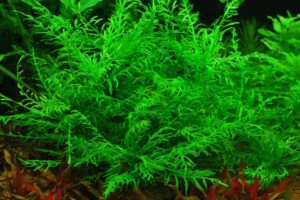
Morphologically, this plant exhibits lanceolate leaves with finely serrated edges, arranged oppositely or in whorls, with a relatively lower leaf count per node compared to forms that align with Limnophila hippuridoides. The stem grows upright, with internodes that can remain relatively compact under optimal conditions.
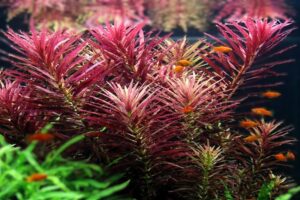
In emersed conditions, the leaves tend to display a bright green coloration with low red pigment intensity. This characteristic distinguishes it visually from other “mini” variants that often appear darker. In submerged conditions, the plant typically develops a yellowish-green tone, showing a stronger tendency to remain within the green spectrum rather than shifting toward red.
Its natural habitat is presumed to be shallow swamp areas or stagnant waters in Southeast Asia, with relatively stable and nutrient-rich conditions. In aquascaping, this plant is used in the midground to background to form plant masses with fine texture and bright coloration that contrasts well with red plants.
Its relatively light and non-dominant coloration makes it effective for creating smooth color transitions within layouts, especially in compositions that require a gradient from green toward warmer tones.
This plant became known among aquascapers through limited distribution by several aquatic plant farms and collectors in Indonesia. One of the parties involved in introducing this variant is Waridefia, which contributed to its presence in the hobby despite the lack of formal botanical documentation.
Requirements and Care
Growth Characteristics
This plant grows vertically following a typical stem plant pattern. Growth is relatively stable, with the ability to produce lateral shoots after trimming. Under sufficient light and nutrient conditions, internodes tend to remain shorter, resulting in a denser appearance.
Under limited light, the plant tends to elongate, with increased spacing between nodes, reducing its visual density.
Light
The light requirement falls within the medium to high category. At approximately ±70–90 µmol m⁻² s⁻¹, the plant can grow steadily with predominantly green coloration. Increasing light intensity to around ±100–140 µmol m⁻² s⁻¹ helps maintain a more compact structure and enhances leaf clarity.
Unlike some species within the same genus, higher light intensity does not necessarily induce strong red coloration, but rather enhances its yellowish-green tone.
CO₂ and Carbon
This plant can adapt to non-CO₂ systems, although growth tends to be slower and less optimal. In systems with stable CO₂ supply, growth becomes more consistent, with a denser structure.
Its CO₂ requirement is considered medium, sufficient to support active growth without the extreme demands of high-demand species.
Nutrients
As a stem plant, nutrient uptake primarily occurs through the water column. Macronutrients such as nitrogen, phosphate, and potassium should be maintained at stable levels to support growth and maintain leaf coloration.
Micronutrients also play a role in maintaining tissue health. Nutrient imbalance may lead to pale leaves or unstable growth.
Water Parameters
This plant is relatively tolerant of parameter variations as long as they remain stable. The ideal pH range is slightly acidic to neutral, with an optimal temperature of 22–27 °C.
Low to moderate water hardness supports efficient nutrient uptake. Sudden parameter fluctuations should be avoided.
Substrate
The use of nutrient-rich substrates such as aquasoil provides advantages during the initial growth phase, particularly for root development. However, as a stem plant, most nutrient uptake still occurs through the water column.
A stable substrate structure helps maintain stem positioning and facilitates replanting after trimming.
Propagation
Propagation is carried out through stem cuttings. The top portion can be cut and replanted into the substrate, where it will develop new roots within a relatively short time.
Regular trimming not only serves as a propagation method but also helps maintain plant shape and encourages lateral growth for increased density.
Conclusion
Limnophila aromatica sp. Kalimantan Mini is an interesting aquascape plant that remains poorly documented from a botanical perspective. Its identity is still informal, and available information is limited, making morphological observation and practical experience the most reliable approach to understanding this plant.
It is well suited for midground to background use, offering stable bright green coloration. In low-tech systems, it can grow with moderate performance, while in high-tech systems with sufficient light and CO₂, it develops a more compact structure and improved aesthetics.
Its primary value lies in its flexibility and its ability to provide subtle visual contrast within aquascape layouts.