Daftar Isi Show
| Characteristics | Detail |
|---|---|
| Genus | Ludwigia |
| Species | Ludwigia repens |
| Family | Onagraceae |
| Origin | North America to Central America |
| Common Name | Red Ludwigia, Creeping Ludwigia |
| Light Requirement | Medium (±60–100 µmol m⁻² s⁻¹ / PAR) |
| Optimal Temperature | 20–28 °C |
| Growth Rate | Moderate to fast |
| Placement | Midground – background |
| Plant Height | 20–50 cm |
| Ideal pH | 5.5–7.5 |
| Water Hardness | GH 3–12 dGH; KH 2–8 dKH |
| CO₂ Requirement | Adaptive |
| Propagation Method | Stem cuttings |
Additional Information
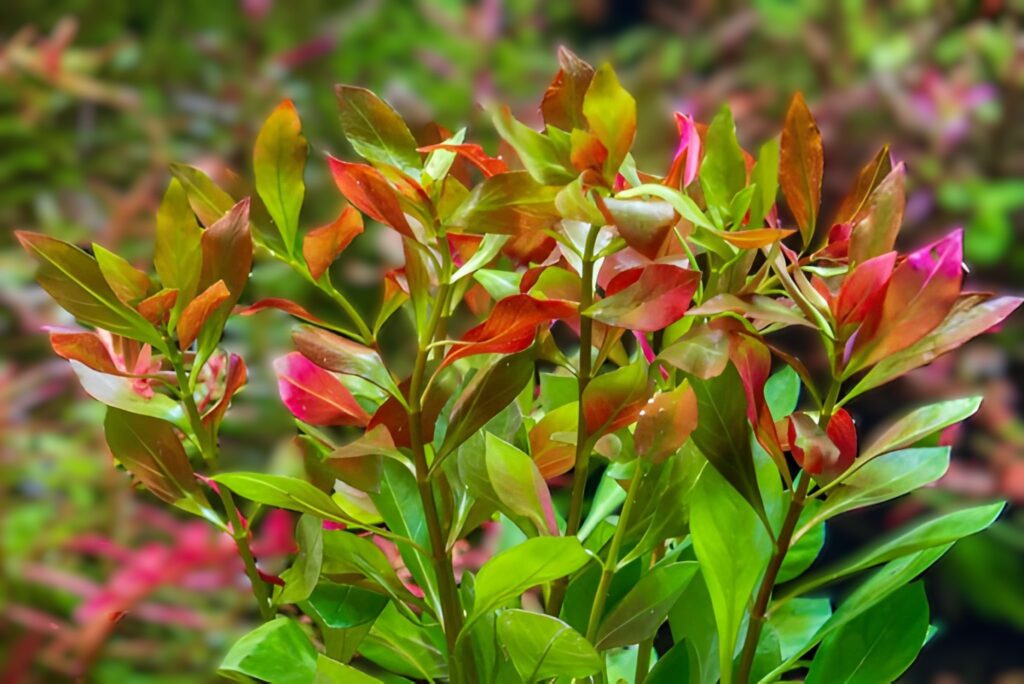
Ludwigia repens is one of the most commonly used stem plants in aquascaping, known for its flexibility across a wide range of conditions and its ability to produce coloration ranging from red to brownish green depending on the environment.
Morphologically, this plant has soft stems with oval to elongated leaves arranged in opposite pairs. The upper side of the leaves tends to display green to red coloration, while the underside often shows a more intense reddish hue, especially under higher lighting conditions.
In its natural habitat, Ludwigia repens is found in shallow waters such as swamps, slow-moving rivers, and lake margins with relatively dynamic environmental fluctuations. This adaptation explains its high tolerance to varying water parameters in aquarium conditions.
In aquascape layouts, this plant is commonly used as a midground to background element. Its warm coloration helps create contrast against dominant green plants while providing a natural visual transition within the composition.
Requirements and Care
Growth Characteristics
Ludwigia repens grows vertically with active lateral branching, especially after trimming. Internodes tend to elongate under low light conditions, while under higher light they become shorter and more compact.
This plant responds well to trimming, making it easy to shape into dense groups. Under optimal conditions, growth can become relatively fast and requires regular pruning to maintain layout proportions.
Light
The light requirement falls within the medium category, with a range of approximately 60–100 µmol m⁻² s⁻¹.
Under low light, the plant remains viable but coloration tends to be pale green with longer internodes. At higher intensity within the medium range, red coloration becomes more pronounced and leaf structure becomes more compact.
If light intensity is too high without proper balance of nutrients and carbon, the plant may experience stress, potentially triggering algae growth on leaf surfaces.
CO₂ and Carbon
This plant is adaptive to CO₂ availability. Ludwigia repens can grow in systems without CO₂ injection (low-tech), but with slower growth and less intense coloration.
In high-tech systems with stable CO₂ injection, growth becomes faster, leaves grow larger, and red coloration becomes more consistent. The response to CO₂ is significant, particularly in terms of leaf density and overall plant health.
Nutrients
As a relatively fast-growing stem plant, Ludwigia repens requires a balanced supply of nutrients, particularly nitrogen, phosphate, and potassium.
Micronutrients such as iron play an important role in supporting red coloration. Nutrient deficiencies are typically indicated by pale leaves, stunted growth, or weakened stems.
Stability in nutrient supply is more important than high but inconsistent dosing.
Water Parameters
This plant is tolerant of a wide range of water parameters. The ideal pH range is 5.5–7.5, with GH 3–12 dGH and KH 2–8 dKH.
The optimal temperature ranges from 20–28 °C. Parameter stability has a greater impact on growth than exact numerical values, particularly in intensive aquascape systems.
Substrate
Ludwigia repens can grow well in various substrate types, including inert and nutrient-rich options. The root system develops sufficiently, so nutrient-rich substrates will support faster and more stable growth.
In inert substrates, the plant can still grow well as long as nutrients are supplied through the water column.
Propagation
Propagation is carried out through stem cuttings. Cut sections can be replanted directly into the substrate and will develop new roots within a relatively short time.
Regular trimming not only helps control plant shape but also serves as the primary method for propagation and increasing plant density.
Conclusion
Ludwigia repens is a highly flexible and adaptable aquascape plant, suitable for a wide range of experience levels, from beginners to advanced aquascapers.
It can be used in both low-tech and high-tech systems, with significantly improved performance under optimal lighting and stable CO₂ conditions. Aesthetically, its red coloration provides important contrast within aquascape layouts, while its responsive growth makes it easy to shape and manage.
As a midground to background plant, Ludwigia repens offers a strong balance between ease of care and visual value, making it one of the most reliable choices for long-term aquascape design.