Daftar Isi Show
| Characteristics | Detail |
|---|---|
| Genus | Myriophyllum |
| Species | Myriophyllum mattogrossense |
| Family | Haloragaceae |
| Origin | South America (Brazil, Peru, Ecuador, Bolivia) |
| Common Name | Matogrosso milfoil |
| Light Requirement | Medium–high (±60–150 µmol m⁻² s⁻¹ / PAR) |
| Optimal Temperature | 23–25 °C |
| Growth Rate | Fast |
| Placement | Background, midground |
| Plant Height | 20–60 cm |
| Ideal pH | 5.0–7.5 |
| Water Hardness | GH 3–10 dGH; KH 2–10 dKH |
| CO₂ Requirement | Adaptive–medium |
| Propagation Method | Stem cuttings |
Additional Information
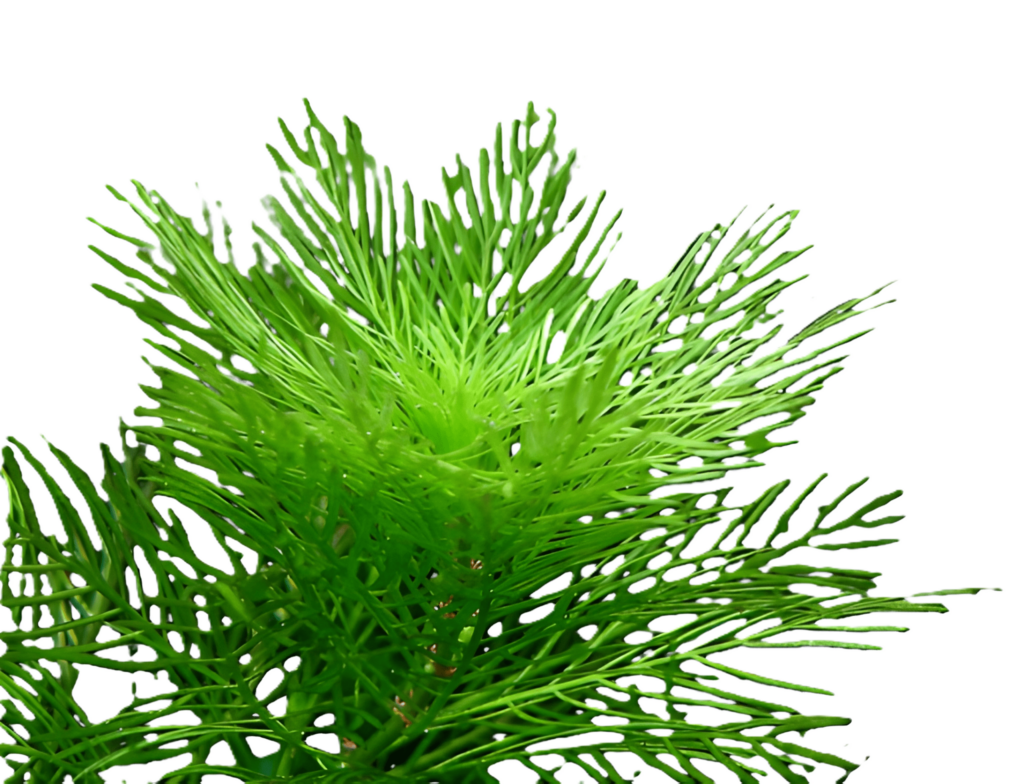
Myriophyllum mattogrossense is a stem plant characterized by fine, feather-like leaves arranged in a whorled pattern. Its highly dissected leaf structure creates a light and contrasting visual texture, especially when placed alongside plants with broader or more solid leaves.
Under adequate lighting conditions, the leaves open into a fan-shaped pattern, producing a wider and more decorative appearance. The plant’s natural coloration is bright green, without red pigmentation, which distinguishes it from other Myriophyllum species that are often confused in the trade.
Its natural habitat consists of shallow waters such as swamps, seasonal ponds, and slow-moving streams with muddy substrates. This ecological adaptation makes the plant relatively flexible in responding to varying environmental conditions in an aquarium setting.
In aquascape layouts, this plant is commonly used as a background or midground filler. Its fine texture is effective in creating smooth visual transitions and enhancing depth, particularly in Nature Aquarium and Dutch-style layouts.
Requirements and Care
Growth Characteristics
This plant exhibits vertical growth with relatively intensive lateral shoot production. Its growth rate is considered fast, especially in systems with high lighting and stable carbon supply.
It responds very well to trimming. Cutting the top portions stimulates new branching, resulting in a denser and bushier plant mass. Without regular trimming, the lower parts of the stem tend to experience shading, leading to a decline in leaf quality.
Light
The lighting category ranges from medium to high, with a PAR range of approximately 60–150 µmol m⁻² s⁻¹.
Under low to moderate light intensity, the plant can still grow stably; however:
Internodes tend to be longer
Leaf structure becomes less dense
Overall appearance appears more sparse
Under high lighting:
Leaves become denser and more expanded
Plant structure becomes more compact
Growth rate increases significantly
Even light distribution is important to prevent lower leaf degradation caused by shading.
CO₂ and Carbon
Myriophyllum mattogrossense is relatively adaptive to carbon availability.
Without CO₂ injection:
The plant can still grow stably
Suitable for low-tech systems with moderate lighting
Growth is slower and leaf size tends to be smaller
With CO₂ injection (around ±20–30 mg/L):
Growth rate increases significantly
Leaves become larger and healthier
Plant structure becomes denser and more aesthetically refined
Consistency of CO₂ supply is more important than achieving excessively high levels.
Nutrients
As a fast-growing plant, its nutrient requirements range from moderate to high.
Key macronutrients:
Nitrate (NO₃) supports stem and leaf growth
Phosphate (PO₄) plays a role in energy metabolism
Potassium (K) supports tissue stability
Micronutrients:
Iron (Fe) is essential for maintaining healthy leaf coloration
Deficiency is typically indicated by pale or whitish new growth
The plant is relatively tolerant of nutrient variation but performs best in systems with stable and balanced nutrient availability.
Water Parameters
Stable water parameters are essential for maintaining consistent growth.
The ideal pH range is between 5.0 and 7.5
Optimal temperature is 23–25 °C, with tolerance between 18–28 °C
Water hardness:
GH 3–10 dGH
KH 2–10 dKH
Extreme fluctuations in parameters may negatively affect growth stability and leaf quality, particularly under high lighting conditions.
Substrate
This plant does not develop a highly complex root system but still benefits from nutrient-rich substrates.
Active or nutrient-rich substrates:
Support faster initial growth
Help stabilize the plant after planting
In inert substrates:
Growth remains possible
Dependence on the water column increases
Roots function more as anchorage rather than the primary source of nutrient uptake.
Propagation
Propagation is carried out vegetatively through stem cuttings.
Common method:
Cutting the shoot tip
Replanting it into the substrate
The remaining parent plant will produce new lateral shoots, accelerating the formation of a denser plant cluster.
This process is relatively easy and has a high success rate, even under suboptimal conditions.
Conclusion
Myriophyllum mattogrossense is a fast-growing aquascape stem plant with fine leaf structure and a high level of adaptability to various aquarium conditions.
It is suitable for:
Low-tech systems with moderate lighting and without CO₂
High-tech systems with high lighting and CO₂ injection for optimal results
Aesthetically, it functions as a background or midground element that provides a light texture and enhances visual depth within a layout.
With relatively simple care requirements yet strong responsiveness to optimized conditions, Myriophyllum mattogrossense represents a stable choice for both beginners and experienced aquascapers.