Daftar Isi Show
| Characteristics | Details |
|---|---|
| Genus | Myriophyllum |
| Species | Myriophyllum aquaticum |
| Family | Haloragaceae |
| Origin | South America (Amazon Basin) |
| Common Name | Parrot Feather, Parrot’s Feather |
| Lighting Requirements | Medium to high (±70–140 µmol m⁻² s⁻¹ PAR) |
| Optimal Temperature | 18–28°C |
| Growth Rate | Fast |
| Placement | Background / emergent / riparium |
| Plant Height | 30–150+ cm |
| Ideal pH | 6.0–7.5 |
| Water Hardness | GH 3–12 dGH; KH 2–8 dKH |
| CO₂ Requirement | Adaptive |
| Propagation | Stem fragmentation, stolons |
Additional Information
Myriophyllum aquaticum is an aquatic stem plant capable of growing in two distinct forms: submerged and emergent. In aquascaping practice, this behavior is critical, as the plant tends to shift toward its emergent form when conditions are favorable, particularly under high lighting and abundant nutrient availability.
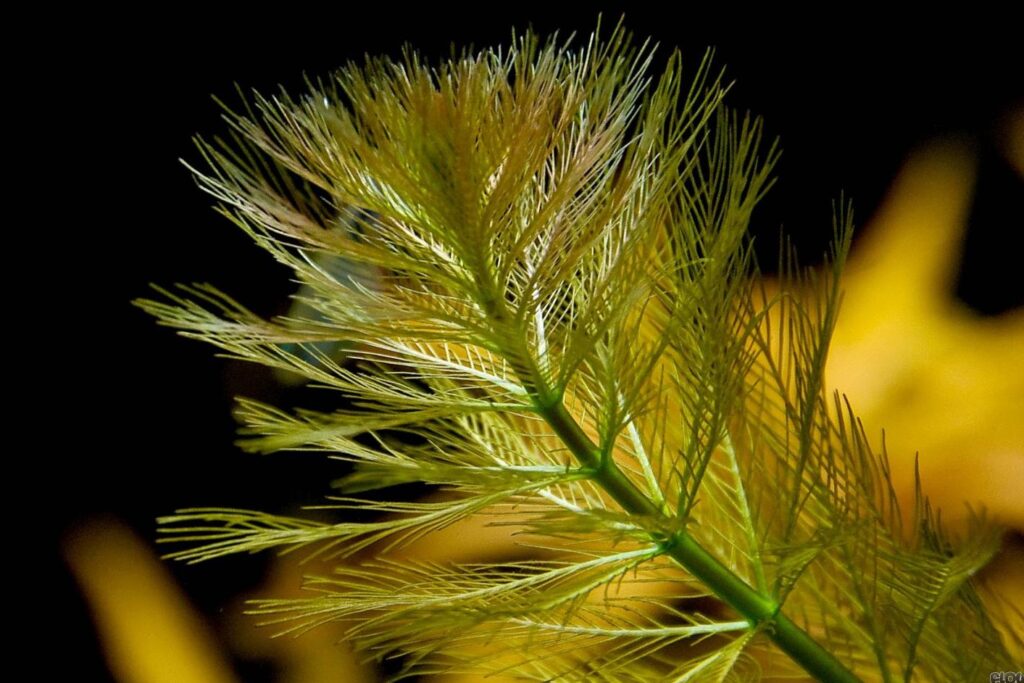
Morphologically, the leaves are arranged in whorls around the stem, with a very fine, feather-like structure. Emergent leaves are more rigid and densely packed, while submerged leaves are softer, longer, and more loosely spaced. This contrast creates a unique textural variation compared to other stem plants.
The stems can grow long and flexible, forming dense networks through stolons and lateral branching. The lower sections of the plant are typically darker, while the tips display bright green coloration with active growth.
In its natural habitat, this species thrives in shallow waters with slow to stagnant flow and high nutrient content. This explains its strong response to eutrophic environments and its ability to produce large amounts of biomass.
In aquascaping, Myriophyllum aquaticum is best suited for background use in setups with ample vertical space, open-top aquariums, and paludarium or riparium systems. Its use in fully submerged aquascapes requires careful consideration due to its tendency to reach the surface and form dense canopies.
Requirements and Care
Growth Characteristics
This plant exhibits vertical growth with lateral expansion through stolons and branching stems. It has a high regenerative capacity, allowing even small fragments to develop into new plants, resulting in rapid spread within the system.
Key characteristics include fast and aggressive growth under nutrient-rich conditions, a strong tendency to form surface canopies, and stem fragmentation as a primary propagation mechanism. In aquariums, if left unmanaged, it can reduce light penetration to lower levels and negatively impact other plants.
Lighting
Lighting requirements fall within the medium to high range. At approximately ±70–90 µmol m⁻² s⁻¹ PAR, growth remains stable with longer internodes. At ±100–140 µmol m⁻² s⁻¹ PAR, growth becomes faster and more compact.
Under lower light conditions, leaves become more spaced out, vertical elongation increases, and overall density decreases. Under higher light intensity, leaves become denser and more compact, apical growth increases, and transition to the emergent form occurs more rapidly. High light without proper nutrient control can lead to excessive growth.
CO₂ and Carbon
This species is highly adaptable and capable of growing without CO₂ injection, maintaining stable growth in low-tech systems. This is due to its efficient carbon uptake from the water column and its tendency to grow near the surface.
In high-tech systems, growth increases significantly, biomass accumulates rapidly, and frequent trimming becomes necessary. While CO₂ is not essential, it accelerates growth and enhances plant density.
Nutrients
The plant is highly responsive to nutrient availability, particularly nitrogen and phosphate. Nutrient-rich environments promote rapid expansion and biomass accumulation.
Nutrient uptake occurs primarily through the water column. The plant is tolerant of excess nutrients and can strongly compete with other species. In aquascaping systems, nutrient control is essential to prevent overdominance.
Water Parameters
Optimal parameters include a pH range of 6.0–7.5, temperature between 18–28°C, GH 3–12 dGH, and KH 2–8 dKH. The plant is tolerant of parameter fluctuations, including changes in temperature and water level. However, stability is still important for maintaining consistent growth patterns.
Substrate
Suitable substrates include aquasoil, sand with nutrient layering, or inert substrates supplemented through the water column. The root system is relatively simple and does not play a dominant role in nutrient uptake, which primarily occurs through stems and leaves.
Propagation
Propagation occurs through stem fragmentation and lateral stolons. Small detached fragments can quickly develop into new plants within a short time. In aquascaping practice, trimming must be controlled and loose fragments should be removed immediately from the aquarium, as uncontrolled spread can occur rapidly.
Conclusion
Myriophyllum aquaticum is a fast-growing stem plant with high adaptability and a strong tendency to grow toward the water surface. It is best suited for background placement in open-top tanks, as well as paludarium and riparium setups, and can be used in both low-tech and high-tech systems with proper maintenance. Its primary value lies in its fine leaf texture and rapid growth, but it requires disciplined management to prevent overgrowth and maintain balance within the aquarium ecosystem.