Daftar Isi Show
| Characteristic | Detail |
|---|---|
| Genus | Limnophila |
| Species | Limnophila aquatica |
| Family | Plantaginaceae |
| Origin | India, Sri Lanka, Southeast Asia |
| Common Name | Giant Ambulia |
| Lighting Requirement | Medium – high (±70–150 µmol m⁻² s⁻¹ / PAR) |
| Optimal Temperature | 22 – 28 °C |
| Growth Rate | Fast |
| Placement | Background |
| Plant Height | 25 – 50+ cm |
| Ideal pH | 6.0 – 7.5 |
| Water Hardness | GH 3–12 dGH; KH 2–12 dKH |
| CO₂ Requirement | Medium – high |
| Propagation | Stem cuttings and runners |
Additional Information
Limnophila aquatica is an aquatic stem plant from the Plantaginaceae family, widely known in aquascaping as Giant Ambulia. Botanically, this species exhibits helophytic characteristics, meaning it can adapt to both submerged and emergent growth conditions. This adaptability is reflected in its heterophylly, where leaf morphology differs significantly between submersed and emersed forms.
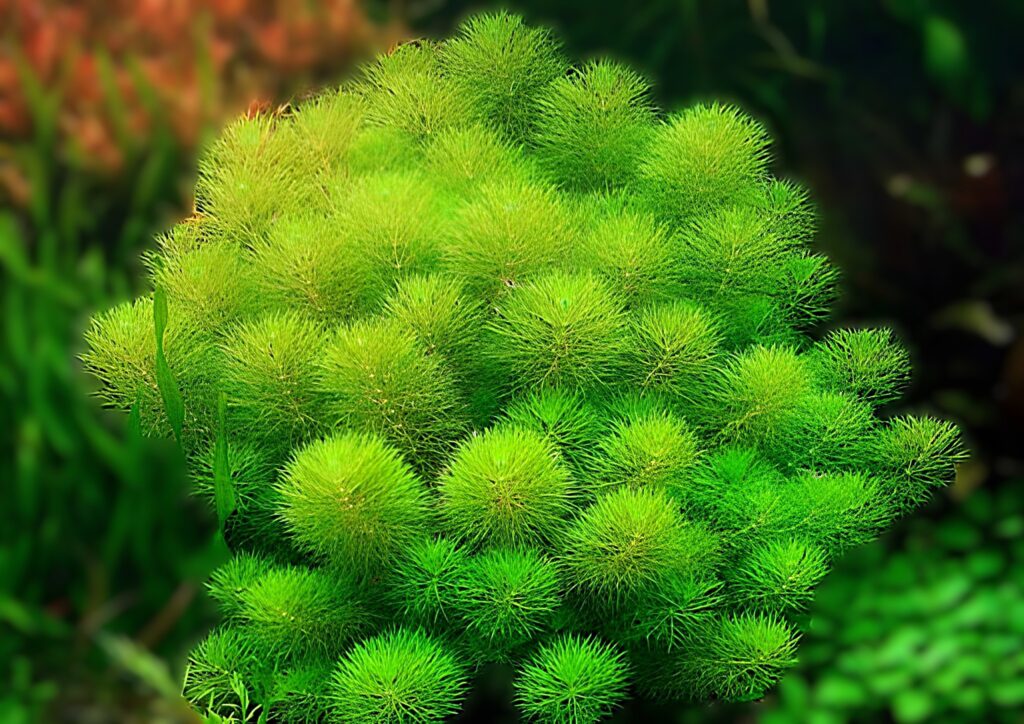
In submerged conditions, its morphology is highly distinctive. Leaves are arranged in whorls around each node, typically consisting of 10 to 12 finely divided segments. The leaf structure is pinnatisect, creating a soft, feathery appearance reminiscent of conifer branches or fine plumage. A single whorl can reach a diameter of 10 to 15 cm, making it one of the widest crown-forming stem plants used in aquascaping.
The stem is slightly swollen at the nodes, providing structural support for its dense foliage. Its light green coloration contributes a fresh and vibrant visual contrast, especially when placed alongside darker or broader-leaved species.
In aquascape layouts, Limnophila aquatica is primarily used as a background plant. Its fine texture is effective in creating depth perception, particularly in Nature Aquarium styles. In Dutch-style aquascapes, it is often trimmed into dense, uniform groups to form structured plant clusters.
In its natural habitat, this species is found in slow-moving waters such as swamps, canals, and seasonal wetlands. When allowed to grow above the water surface, it transitions into its emersed form, producing firmer leaves and occasionally developing blue to violet flowers near the apical region.
Care and Requirements
Growth Characteristics
The growth pattern of Limnophila aquatica is predominantly vertical and highly vigorous. Growth occurs through the apical meristem, but under optimal conditions, the plant also produces lateral shoots from leaf axils, forming a dense and bushy structure.
Internode length is a key indicator of environmental conditions. Adequate light and nutrients result in short, compact internodes. In contrast, insufficient light leads to elongated stems with wider spacing between leaves.
In addition to vertical growth, the plant can spread horizontally through runners along the substrate. This allows rapid colonization of the background area.
Lighting
This species requires medium to high lighting, with a PAR range of approximately 70 to 150 µmol m⁻² s⁻¹. Under medium light, growth remains stable with moderate leaf density. Under high light, the plant reaches optimal performance, showing compact internodes, maximum whorl diameter, and brighter green coloration.
In low light conditions, the plant tends to become leggy, with reduced leaf size and increased risk of lower leaf loss due to insufficient light penetration.
Due to its large total leaf surface area, Limnophila aquatica is sensitive to imbalances between light and carbon availability. High light without adequate CO₂ often leads to algae issues or tissue damage.
CO₂ and Carbon
The CO₂ requirement is medium to high. While the plant can survive without additional CO₂ injection, its growth form is typically less desirable, with thinner stems and less dense foliage.
In high-tech systems with stable CO₂ levels around 20–30 ppm, the plant develops a much more compact and lush appearance. Photosynthetic activity increases significantly and is often visible through strong pearling.
CO₂ stability is critical. Fluctuations can cause stress, leading to leaf deterioration, especially due to the plant’s delicate leaf structure.
Nutrients
As a fast-growing species, Limnophila aquatica has a high nutrient demand. Adequate supply of macronutrients such as nitrogen, phosphorus, and potassium is essential to sustain vigorous vegetative growth.
Micronutrients, particularly iron, play a crucial role in maintaining healthy coloration and apical development. Nutrient deficiencies are quickly reflected in leaf condition and growth quality.
Nutrient uptake occurs both through the water column and the root system, making overall balance essential.
Water Parameters
This species is relatively adaptable as long as water parameters remain stable. The ideal pH range is between 6.0 and 7.5, with slightly acidic conditions generally promoting better performance.
Recommended hardness ranges are GH 3–12 dGH and KH 2–12 dKH. Very hard water may lead to mineral deposits on leaf surfaces, which can interfere with photosynthesis.
Optimal temperature ranges from 22 to 28 °C. Higher temperatures can accelerate metabolism but may result in less compact growth if not supported by sufficient light and nutrients.
Substrate
The root system of Limnophila aquatica is moderately developed and contributes to nutrient absorption. Active substrates with high cation exchange capacity provide a more stable nutrient supply in the root zone.
Growth in inert substrates such as sand or gravel is possible but typically less optimal without additional nutrient supplementation. Adequate substrate depth is important to anchor the plant securely due to its size and buoyancy.
Substrate porosity is also important to prevent anaerobic conditions around the roots.
Propagation
Propagation is most commonly done through stem cuttings. Healthy top sections of approximately 10 to 15 cm can be cut and replanted after removing the lower leaves.
The remaining base stem in the substrate will usually produce new shoots from existing nodes, increasing plant density.
Additionally, naturally occurring runners can be separated and replanted to expand coverage.
Conclusion
Limnophila aquatica is a background aquascape plant with strong visual impact due to its fine leaf texture and large crown diameter. Its growth is fast and highly responsive to lighting and CO₂, making it particularly well-suited for high-tech systems.
Although it can survive in less demanding setups, optimal results are achieved when light, carbon, and nutrient parameters are consistently maintained. In aquascape design, this species is highly effective for creating depth, texture contrast, and dense green mass.
With proper management, Giant Ambulia serves not only as a visually striking plant but also as an indicator of overall aquarium ecosystem balance.