Daftar Isi Show
| Characteristics | Details |
|---|---|
| Genus | Ludwigia |
| Species | Ludwigia sphaerocarpa |
| Family | Onagraceae |
| Origin | North America |
| Common Name | No widely established common name in aquascaping |
| Light Requirement | Medium–high (±70–140 µmol m⁻² s⁻¹ / PAR) |
| Optimal Temperature | 20–28°C |
| Growth Rate | Moderate |
| Placement | Foreground (tall) – midground |
| Plant Height | 15–40 cm |
| Ideal pH | 5.5–7.2 |
| Water Hardness | GH 2–10 dGH; KH 1–5 dKH |
| CO₂ Requirement | Medium |
| Propagation | Stem cuttings |
Additional Information
Ludwigia sphaerocarpa is a stem plant from the Onagraceae family, native to shallow freshwater habitats in North America such as swamps, riverbanks, and slow-moving waters. It is adapted to relatively stable environmental conditions with moderate fluctuations in light and water levels.
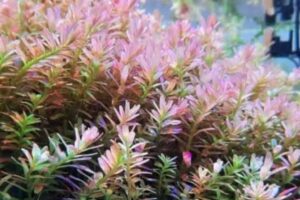
Morphologically, this plant features upright stems with small, oval to oblong leaves arranged oppositely. Its relatively smaller leaf size compared to other Ludwigia species is a key distinguishing characteristic. Leaf coloration is typically bright green, with the potential to shift toward yellowish to soft orange tones under higher light intensity and balanced nutrient conditions.
In aquascaping, Ludwigia sphaerocarpa is often used as a tall foreground to midground plant. Its fine leaf structure and compact growth habit make it effective as a transitional element between low-growing foreground plants and larger background stem plants. With proper trimming techniques, it can form dense and controlled plant masses.
Requirements and Care
Growth Characteristics
Ludwigia sphaerocarpa grows vertically as a stem plant with the ability to branch after trimming. Under optimal conditions, it exhibits relatively compact growth with short internodes.
In low light or without adequate carbon supply, the plant tends to elongate (etiolation), resulting in a more open structure and increased height. Conversely, under higher light and stable carbon conditions, growth becomes denser and more compact, with improved responsiveness to trimming, allowing for better structural control in the foreground to midground area.
Light
The light category ranges from medium to high, with an effective range of approximately ±70–140 µmol m⁻² s⁻¹ (PAR).
At medium light intensity, the plant grows steadily with predominantly green coloration and a slightly looser structure. As light intensity increases, leaf density improves, internodes shorten, and there is potential for warmer hues such as yellowish to light orange to appear.
Insufficient light leads to elongated growth, while high light without balanced nutrients may destabilize the system.
CO₂ and Carbon
Ludwigia sphaerocarpa has a medium carbon requirement. It can survive in systems without CO₂ injection, but with slower growth and less compact structure.
In systems with stable CO₂ injection, the plant shows significant improvement in performance, particularly in leaf density, growth rate, and trimming response. In high-tech setups, stable CO₂ supply is an important factor in maintaining optimal plant form in the foreground to midground zone.
Nutrients
This plant absorbs nutrients both from the water column and through its root system. Availability of macronutrients such as nitrogen, phosphorus, and potassium supports vegetative growth, while micronutrients such as iron contribute to maintaining leaf coloration quality.
Nutrient balance is critical. Imbalances may result in pale leaves, slow growth, or structural deformation.
Water Parameters
Ideal water parameters:
pH: 5.5–7.2
Temperature: 20–28°C
GH: 2–10 dGH
KH: 1–5 dKH
The plant is relatively tolerant of parameter variations, but stability remains the key factor for consistent growth. Soft to moderately hard water is generally preferred.
Extreme fluctuations in temperature or water chemistry may induce physiological stress and disrupt plant metabolism.
Substrate
The use of nutrient-rich substrate supports root system development and enhances plant stability, especially during the initial planting phase. A well-structured substrate also helps maintain stem anchoring.
As a stem plant, Ludwigia sphaerocarpa is not entirely dependent on substrate, but a stable substrate contributes to long-term growth consistency.
Propagation
Propagation is carried out through stem cuttings. Healthy top or stem sections are cut and replanted into the substrate.
In aquascaping practice, routine trimming is performed to maintain plant height and density. Trimmed tops can be reused to propagate new plants and preserve consistent layout structure.
Conclusion
Ludwigia sphaerocarpa is a stem plant characterized by small leaves and growth that can be effectively controlled through light, CO₂, and trimming techniques. In aquascaping, it is best suited for tall foreground to midground placement, particularly in systems with adequate lighting and carbon supply.
The plant can adapt to low-tech systems but demonstrates its best performance in stable high-tech setups. Aesthetically, Ludwigia sphaerocarpa functions as a subtle transitional element, providing visual balance between different plant layers within an aquascape layout.