Daftar Isi Show
| Characteristics | Details |
|---|---|
| Genus | Ludwigia |
| Species | Ludwigia brevipes |
| Family | Onagraceae |
| Origin | North America (southeastern United States) |
| Common Name | Ludwigia brevipes |
| Light Requirement | Medium–high (±70–150 µmol m⁻² s⁻¹ / PAR) |
| Optimal Temperature | 20–28 °C |
| Growth Rate | Moderate |
| Placement | Midground – background |
| Plant Height | 15–40 cm |
| Ideal pH | 5.5–7.5 |
| Water Hardness | GH 2–10 dGH; KH 0–6 dKH |
| CO₂ Requirement | Medium – high |
| Propagation | Stem cuttings |
Additional Information
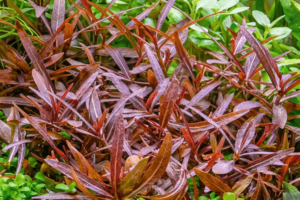
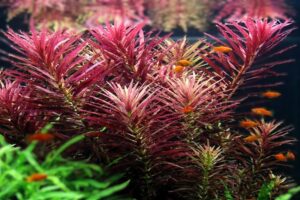
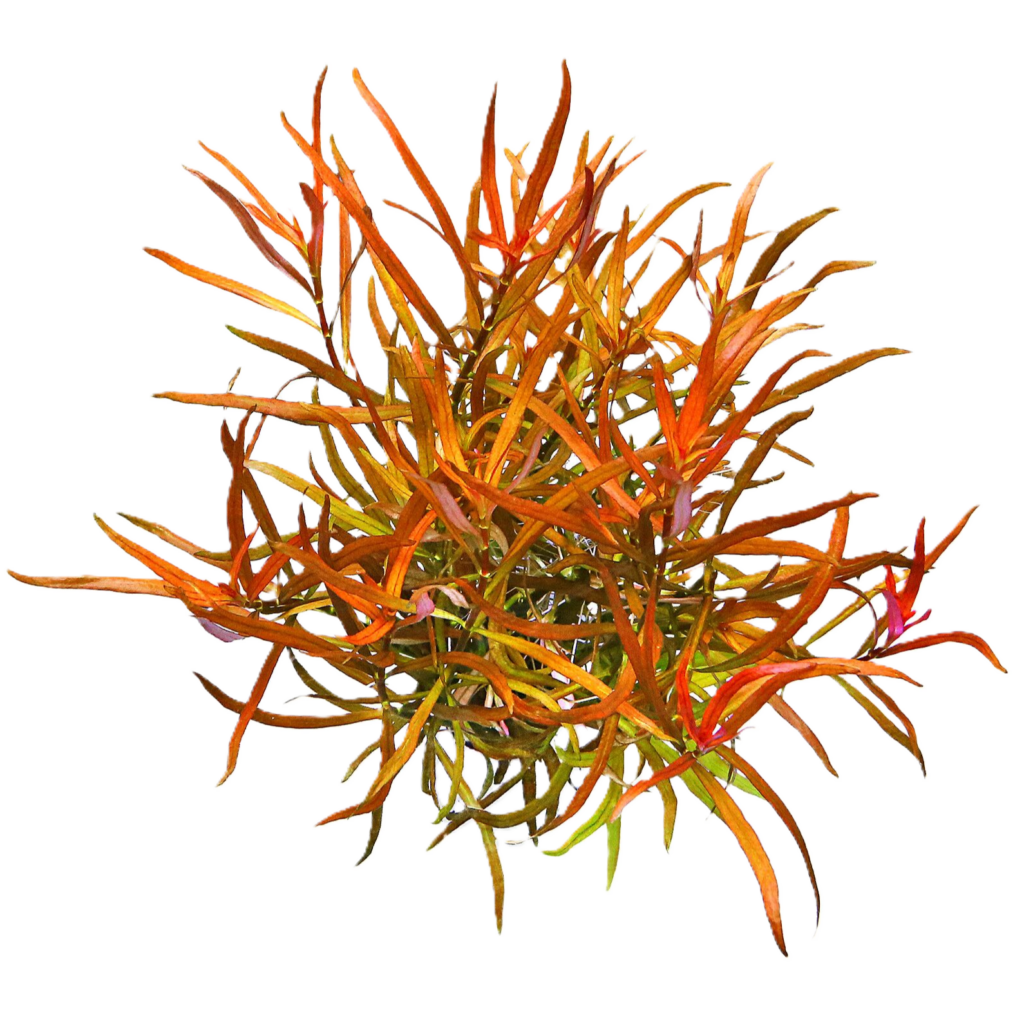
Ludwigia brevipes is a stem plant from the Onagraceae family, recognized for its narrow, elongated leaves arranged in opposite pairs along the stem. Under optimal conditions, leaf coloration ranges from bright green to orange-reddish, depending on light intensity and nutrient availability, particularly nitrogen and micronutrients.
Morphologically, the plant has relatively slender stems with internodes that may elongate under low light conditions, while under high light it tends to grow more compact and dense. The leaves are smaller compared to some other Ludwigia species such as Ludwigia repens, resulting in a finer visual texture within aquascape layouts.
Its natural habitat includes shallow waters such as swamps, slow-moving rivers, and flooded areas in North America. This adaptation makes it relatively flexible to varying water conditions, although optimal performance is achieved in stable systems.
In aquascaping, Ludwigia brevipes is commonly used as a midground to background plant. Its fine leaf structure and variable coloration make it effective as a visual transition between predominantly green plants and more intensely red species.
Requirements and Care
Growth Characteristics
This plant grows vertically with active lateral branching when trimmed regularly. Its response to light is significant—under high intensity, growth becomes denser with shorter internodes, while under low light it tends to elongate and lose compactness.
With adequate carbon supply, Ludwigia brevipes exhibits more stable and consistent growth, particularly in color development.
Light
The light category ranges from medium to high, with an effective range of approximately ±70–150 µmol m⁻² s⁻¹.
At lower intensities (below ±60 µmol), the plant can survive, but coloration tends to remain pale green and structure becomes less compact.
At higher intensities (≥90 µmol), coloration shifts toward orange or reddish tones, and growth becomes denser and more suitable for refined aquascape layouts.
CO₂ and Carbon
This plant can survive without CO₂ injection (low-tech systems), but with limited performance—slower growth, less optimal coloration, and a tendency toward elongated structure.
In high-tech systems with stable CO₂ levels (around 20–30 ppm), growth response improves significantly, including increased leaf density and color intensity. Therefore, it is practically categorized as a medium to high CO₂ requirement plant.
Nutrients
Ludwigia brevipes requires a balanced supply of macronutrients (nitrogen, phosphate, potassium) and micronutrients (iron, manganese, trace elements).
Nitrogen plays a key role in maintaining vegetative growth, while excessively low nitrogen levels may induce red coloration but risk inhibiting growth if not balanced.
Iron availability also contributes to leaf color intensity, especially under high light conditions.
Water Parameters
This plant is relatively tolerant of varying water parameters, with an ideal pH range of 5.5–7.5.
Low to moderate water hardness (GH 2–10 dGH and KH 0–6 dKH) provides optimal conditions for growth and metabolic stability.
Parameter stability is far more important than achieving specific numerical values, particularly in high-light systems.
Substrate
As a stem plant, Ludwigia brevipes is not fully dependent on nutrient-rich substrate, but a stable substrate with nutrient retention capacity provides clear advantages.
Roots function primarily as anchoring structures and supplementary nutrient absorption pathways, while most nutrients are also absorbed through the water column. Active substrates can help maintain pH stability and provide long-term nutrient availability.
Propagation
Propagation is performed through stem cuttings.
Stems are cut at selected sections and replanted into the substrate. Under optimal conditions, cuttings quickly develop roots and new shoots.
Regular trimming not only aids propagation but also enhances plant density and overall aesthetics within the layout.
Conclusion
Ludwigia brevipes is an aquascape plant with fine stem structure and flexible coloration, making it an effective choice for midground to background placement.
It can adapt to low-tech systems, but achieves optimal performance in high-tech setups with medium–high lighting and stable CO₂ supply. Its primary value lies in its fine leaf texture, responsive coloration to light, and ability to form dense structures through trimming.
Functionally and aesthetically, Ludwigia brevipes serves well as a transitional element in aquascape compositions that require detail and visual balance.