Daftar Isi Show
| Characteristic | Detail |
|---|---|
| Genus | Taxiphyllum |
| Species | Taxiphyllum barbieri |
| Family | Hypnaceae |
| Origin | Southeast Asia |
| Common Name | Java Moss |
| Light Requirement | Low to medium (±20–70 µmol m⁻² s⁻¹ / PAR) |
| Optimal Temperature | 18–28 °C |
| Growth Rate | Moderate |
| Placement | Foreground / Midground (hardscape) |
| Plant Height | ±3–10 cm, potentially longer depending on the growing surface |
| Ideal pH | ±5.5–7.5 |
| Water Hardness | GH 1–10 dGH; KH 0–5 dKH |
| CO₂ Requirement | Adaptable |
| Propagation | Thallus fragmentation through cutting and reattachment |
Additional Information
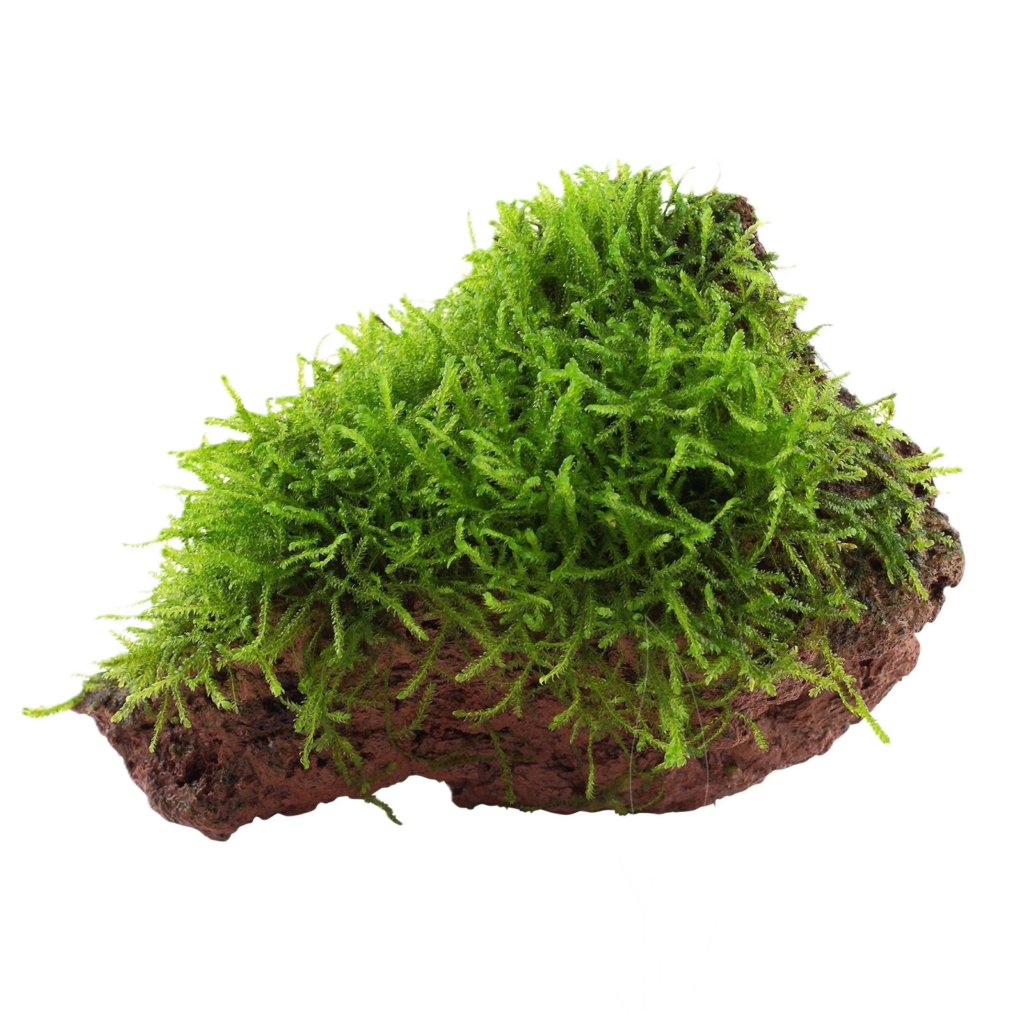
Taxiphyllum barbieri is an aquatic moss characterized by finely branched thalli and a relatively vigorous lateral growth habit compared with many other aquarium mosses. Its irregularly branching morphology gradually develops into dense masses that readily establish themselves on solid surfaces.
Visually, this moss creates a natural texture resembling submerged vegetation found in freshwater environments. Its flexible growth form makes Taxiphyllum barbieri particularly useful for covering driftwood, stones, and other hardscape elements, as well as filling gaps between structural components within an aquascape.
The species is associated with freshwater environments in Southeast Asia, where it is exposed to tropical temperatures and variable aquatic conditions. This ecological adaptability contributes to its reputation as one of the more tolerant mosses used in aquarium cultivation.
In aquascaping, Taxiphyllum barbieri is primarily cultivated as an epiphyte on hardscape from the foreground to the midground. Its dense branching structure also provides valuable microhabitat for microorganisms and can serve as shelter for small aquatic fauna, particularly shrimp and juvenile organisms.
Care and Requirements
Growth Characteristics
Taxiphyllum barbieri develops as an epiphytic moss with predominantly lateral and radial growth. Its branching thalli gradually form dense colonies and can spread across adjacent hardscape surfaces when left untrimmed.
The growth rate is generally moderate and responds noticeably to available light, carbon, and nutrients. Under favorable conditions, new branches develop continuously and increase the overall density of the colony.
Regular trimming is recommended to prevent excessive internal shading and maintain healthy water circulation through the colony. Dense, unmanaged growth can trap organic debris and reduce light penetration into older sections, eventually causing deterioration in the interior of the moss mass.
Selective pruning also allows the aquascaper to maintain the desired shape and prevent the moss from overtaking nearby hardscape or plant species.
Lighting
The lighting requirement of Taxiphyllum barbieri falls within the low to medium range, approximately 20–70 µmol m⁻² s⁻¹ PAR.
Under low light, growth tends to be more open, with longer intervals between branches and a relatively loose colony structure. Moderate lighting encourages denser branching and a more compact appearance.
High light is generally unnecessary and can increase the risk of algae colonization, particularly when nutrient and carbon availability are not properly balanced. Because moss has a complex, highly branched surface, filamentous algae can become deeply embedded within the colony and difficult to remove.
Moderate and stable lighting is therefore generally preferable for long-term maintenance.
CO₂ and Carbon
Taxiphyllum barbieri is highly adaptable to carbon availability and can grow successfully without injected CO₂. This makes it suitable for low-tech aquariums as well as CO₂-enriched high-tech systems.
In aquariums with stable CO₂ supplementation, colony density and growth consistency may improve, allowing the moss to develop more controlled and compact branching.
CO₂ fluctuations generally do not result in acute tissue damage, but stable carbon availability supports more predictable growth and helps maintain consistent colony morphology.
Nutrients
Taxiphyllum barbieri primarily absorbs nutrients directly from the water column through its thallus surface. Consistent availability of both macronutrients and micronutrients is therefore important for maintaining healthy growth.
Nitrogen, phosphorus, potassium, and trace elements should be maintained at balanced concentrations. Excessive nutrient accumulation, particularly when combined with strong lighting, can increase the likelihood of filamentous algae developing throughout the moss colony.
Because the entire thallus is exposed to the surrounding water, good circulation is also important for maintaining efficient nutrient exchange and preventing the accumulation of organic material.
A balanced fertilization strategy is preferable to excessive nutrient dosing.
Water Parameters
Taxiphyllum barbieri is highly tolerant of a broad range of freshwater conditions.
A pH range of approximately 5.5–7.5 and a temperature of 18–28 °C are generally suitable for long-term cultivation. Low to moderate water hardness, around GH 1–10 dGH and KH 0–5 dKH, is also well tolerated.
Parameter stability is more important than maintaining an exact numerical value. Sudden changes in temperature, pH, hardness, or nutrient concentration can cause physiological stress and may temporarily disrupt colony development.
Good water circulation further supports healthy growth by reducing detritus accumulation within dense moss structures.
Substrate
As an epiphytic species, Taxiphyllum barbieri does not require substrate for direct growth.
It can be attached to driftwood, rocks, roots, or other hardscape using thread, aquarium-safe cyanoacrylate gel, or suitable mesh. Over time, the moss develops attachment structures that allow it to establish naturally on the growing surface.
A stable hardscape surface is important for preventing unwanted detachment and uncontrolled dispersal of fragments. When attached properly, the moss can gradually cover complex surfaces while following their underlying contours.
Propagation
Propagation is primarily performed through thallus fragmentation. Small sections of a healthy colony can be separated and attached to new hardscape, where they gradually develop into independent colonies.
This method is widely used in aquascaping because it is simple, efficient, and involves minimal risk to the parent colony.
Fragments should ideally be distributed in thin layers rather than densely packed onto a single surface. Excessive thickness can restrict water circulation and light penetration, increasing the likelihood of organic accumulation and deterioration within the colony.
Conclusion
Taxiphyllum barbieri is a highly adaptable epiphytic aquascape plant valued for its finely branched structure and natural textural appearance. Its tolerance of relatively broad environmental conditions makes it suitable for low-tech through high-tech aquarium systems.
The species generally performs best under low to moderate lighting, balanced nutrition, stable carbon availability, and consistent water parameters. Regular trimming is beneficial for maintaining healthy colony structure and preventing excessive internal shading or algae accumulation.
As a foreground to midground hardscape plant, Taxiphyllum barbieri provides both aesthetic and ecological value. Its dense branching structure can soften hardscape transitions, create natural vegetation textures, and provide microhabitat for microorganisms and small aquatic fauna, making it a versatile component of professionally designed aquascapes.