Daftar Isi Show
| Characteristic | Detail |
|---|---|
| Genus | Cryptocoryne |
| Species | Cryptocoryne parva |
| Family | Araceae |
| Origin | Sri Lanka |
| Common Name | Crypt Parva |
| Light Requirement | Medium to high (±60–120 µmol m⁻² s⁻¹ / PAR) |
| Optimal Temperature | 22–28 °C |
| Growth Rate | Slow |
| Placement | Foreground |
| Plant Height | ±3–8 cm |
| Ideal pH | ±6.0–7.5 |
| Water Hardness | GH 2–10 dGH; KH 1–5 dKH |
| CO₂ Requirement | Adaptable to moderate |
| Propagation | Runners (stolons) and division of established clumps |
Additional Information
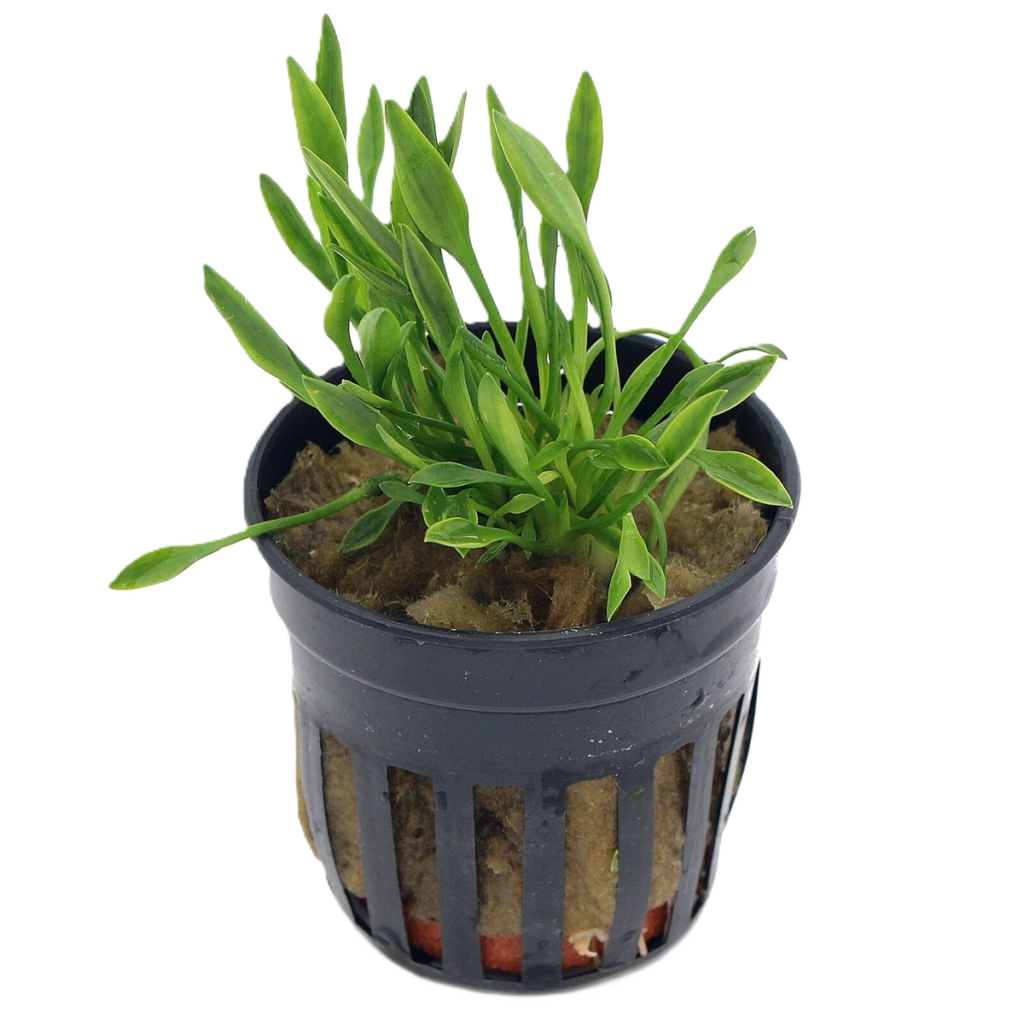
Cryptocoryne parva is one of the smallest Cryptocoryne species commonly cultivated in aquascaping. It develops narrow, elongated leaves with a relatively firm texture compared with many broader-leaved members of the genus. The foliage is typically medium green to dark green, with coloration and growth density influenced by light intensity, carbon availability, and nutrient conditions.
Its compact stature makes Cryptocoryne parva particularly valuable for creating a realistic and visually controlled foreground. Unlike many carpeting plants that spread rapidly or form extremely dense mats, this species maintains a relatively structured rosette appearance, allowing individual plants to remain visually distinguishable.
The species is native to Sri Lanka, where it occurs in shallow aquatic environments with mineral-rich substrates and relatively slow-moving water. Its ecological adaptation allows it to tolerate a reasonably broad range of aquarium conditions, although it is notably sensitive to sudden environmental changes.
In aquascaping, Cryptocoryne parva is frequently used as a low-profile foreground plant in nature aquariums and minimalist compositions. Its consistently low growth habit makes it particularly useful when maintaining realistic scale is more important than achieving a rapidly spreading carpet.
Care and Requirements
Growth Characteristics
Cryptocoryne parva develops as a compact rosette with a well-established root system growing into the substrate. New leaves emerge from the central crown, while vegetative propagation occurs through short runners that spread around the parent plant.
The growth rate is naturally very slow, particularly in systems without supplemental CO₂. Even under favorable conditions, the plant generally expands gradually rather than rapidly covering large areas.
Once established and properly rooted, however, Cryptocoryne parva can maintain remarkably consistent growth. This makes it particularly suitable for aquascapes where long-term stability and predictable plant height are more important than rapid biomass production.
Because of its slow metabolism and gradual expansion, newly planted specimens should not be disturbed unnecessarily. Allowing the root system to establish is one of the most important factors in achieving reliable long-term growth.
Lighting
The lighting requirement of Cryptocoryne parva falls within the medium to high range, approximately 60–120 µmol m⁻² s⁻¹ PAR.
Under lower light intensity, growth becomes considerably slower and the leaves may become longer and more widely spaced as the plant attempts to maximize light capture.
Under moderate to higher light, the foliage generally remains shorter and more compact, producing a cleaner and more controlled foreground appearance.
High light without adequate nutrient and carbon availability can increase algae pressure around the plants. Since Cryptocoryne parva grows slowly, excess light can create a significant imbalance between photosynthetic demand and actual biomass production.
For this reason, light intensity should always be considered together with CO₂ availability, nutrient supply, and aquarium stability.
CO₂ and Carbon
Cryptocoryne parva can survive without injected CO₂, but growth is typically extremely slow under non-CO₂ conditions.
Stable CO₂ supplementation can improve overall growth consistency, accelerate establishment after planting, and encourage more reliable runner production. The effect is particularly noticeable in high-tech aquariums where light intensity is also elevated.
Sudden changes in CO₂ availability or broader environmental conditions can trigger crypt melt, a phenomenon in which existing leaves deteriorate rapidly after environmental disruption. Although this can appear severe, established plants often recover by producing new foliage once stable conditions are restored.
For this reason, consistency is generally more important than maximizing CO₂ concentration.
Nutrients
Cryptocoryne parva obtains a substantial proportion of its nutrition through its root system. A nutrient-rich substrate therefore plays a particularly important role in supporting long-term growth.
Macronutrients such as nitrogen, phosphorus, and potassium, together with essential micronutrients, should remain available at consistent levels. Nutrients in the water column can supplement root-based uptake but should not be considered the sole nutritional source.
Nutrient deficiency may result in prolonged growth stagnation without producing dramatic visible symptoms. This can make diagnosis difficult because the plant may simply appear unchanged for an extended period.
Patience and consistent nutrient availability are therefore essential when cultivating this species.
Water Parameters
Suitable water conditions generally fall within a pH range of approximately 6.0–7.5, with temperatures between 22–28 °C.
Low to moderate water hardness, around GH 2–10 dGH and KH 1–5 dKH, is generally suitable for stable growth.
As with other Cryptocoryne species, stability is more important than maintaining an exact numerical value. Sudden changes in pH, temperature, hardness, or water chemistry can induce physiological stress and may result in temporary leaf loss.
Once the plant has re-established its root system and environmental conditions become stable, new foliage should gradually replace deteriorated leaves.
Substrate
A fine to medium-grained substrate with a stable structure is strongly recommended for supporting the root system and runner development.
Both active aquasoil and inert substrates can be used, provided sufficient nutrients are available within the root zone. The substrate should have adequate depth to allow roots and runners to develop without being repeatedly disturbed.
Excessively coarse substrate can interfere with runner establishment and make it more difficult for young plantlets to become firmly rooted.
A stable substrate is particularly important because Cryptocoryne parva relies heavily on its root system and requires considerable time to establish after transplantation.
Propagation
Propagation is primarily achieved through runners that develop beneath or across the substrate.
As the parent plant matures, new plantlets can develop along these runners and gradually establish their own root systems. They may be left in place to form a natural colony or carefully separated once sufficiently established.
When dividing plantlets, it is preferable to ensure that each new section has an independent root system before transplantation. This reduces stress and improves the probability of successful establishment.
Because propagation is naturally slow, Cryptocoryne parva is better suited to gradual, long-term foreground development than rapid carpet formation.
Conclusion
Cryptocoryne parva is a compact aquascape plant valued for its exceptionally low growth habit, slow development, and stable foreground structure. Its small stature makes it particularly effective for aquascapers who prioritize realistic scale, controlled composition, and long-term visual consistency.
The species can survive in non-CO₂ systems, although stable CO₂ supplementation, adequate lighting, and a nutrient-rich substrate significantly improve establishment and growth. Because it is highly sensitive to sudden environmental changes, maintaining stable aquarium conditions is especially important.
As a foreground plant, Cryptocoryne parva provides a refined alternative to conventional carpeting species. With stable water parameters, appropriate substrate nutrition, and sufficient light, it can form a clean, low-profile foreground that remains visually consistent over the long term and complements both nature-style and high-tech aquascaping compositions.