Daftar Isi Show
| Characteristic | Detail |
| Genus | Rotala |
| Species | Rotala macrandra |
| Family | Lythraceae |
| Origin | India |
| Common Name | Rotala macrandra ‘Tiger’ |
| Light Requirement | High to Very High (±120–250 µmol m⁻² s⁻¹ / PAR) |
| Optimal Temperature | 22–28 °C |
| Growth Rate | Moderate |
| Placement | Midground – Background |
| Plant Height | 20–50 cm |
| Ideal pH | 5.5–6.8 |
| Water Hardness | GH 1–6 dGH; KH 0–3 dKH |
| CO₂ Requirement | High |
| Propagation | Stem cutting |
Additional Information
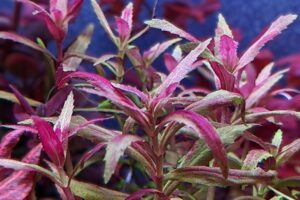
Rotala macrandra ‘Variegated’ is a cultivar of the species Rotala macrandra widely known in the aquascaping trade under the name Rotala macrandra ‘Tiger’. Taxonomically, the two names represent the same plant, with ‘Tiger’ serving as a commercial designation for its distinct variegated or striped leaf pattern.
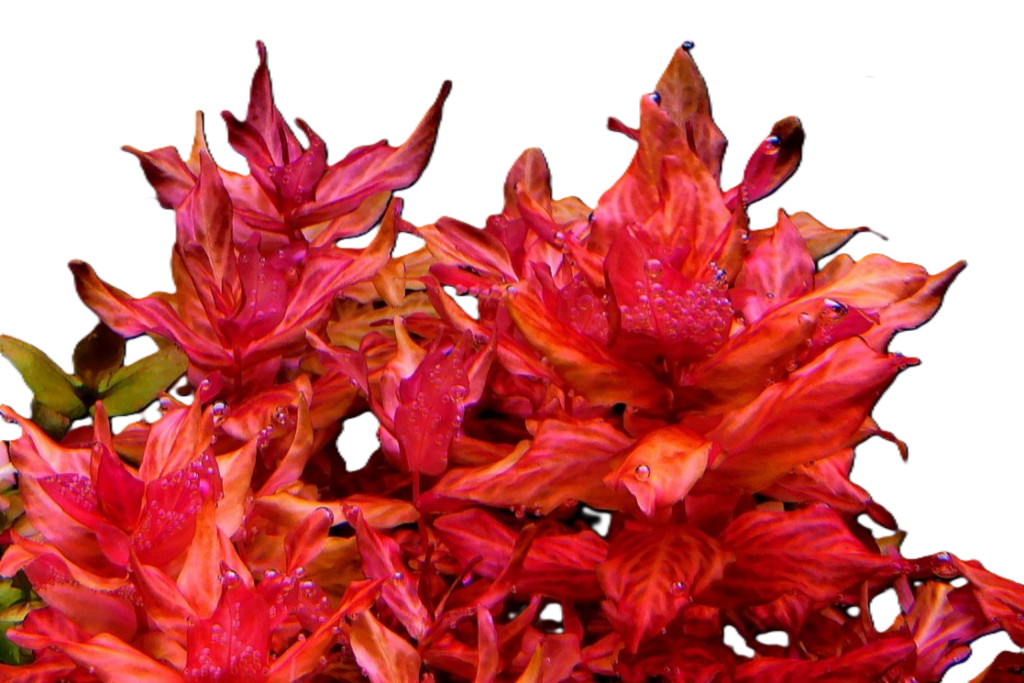
Morphologically, the plant features soft stems with opposite, elliptical to tapering oval leaves. Its defining characteristic is the uneven distribution of chlorophyll across the leaf tissue, which creates a vibrant mixture of bright red, pink, orange, and yellow hues on a single blade. Under intense lighting, these high-contrast striped patterns become exceptionally pronounced, earning it the ‘Tiger’ monicker.
In its native habitats across India, the species grows in shallow waters exposed to intense sunlight and gentle water currents. Within aquascapes, it is primarily used in the background to establish a striking, high-contrast visual focal point, particularly in high-tech systems governed by strict parameter control.
Care and Requirements
Growth Characteristics
This species grows vertically with elongated stems. Node spacing shortens significantly under high light and stretches when light is insufficient. Compared to the non-variegated wild form, this cultivar possesses lower photosynthetic efficiency because parts of its leaf tissue lack chlorophyll, making it far more dependent on high light energy and system stability. Regular trimming is essential to maintain canopy density and prevent lower leaves from shedding due to shading.
Lighting
Lighting requirements fall into the high to very high category, with an effective range of 120 to 250 µmol m⁻² s⁻¹ PAR at leaf level. While the plant can survive around 90 to 120 µmol m⁻² s⁻¹ PAR, leaf coloration and variegated contrast will remain sub-optimal. Under high light, the red tones deepen, the variegated contrast sharpens, and stem structure stays compact. Conversely, low light leads to elongated internodes, faded coloration, and an increased risk of tissue melting. Systems running PAR levels above 150 µmol m⁻² s⁻¹ PAR require meticulously balanced CO₂ and nutrient delivery to prevent algae issues.
CO₂ and Carbon
Carbon requirements are high, making this plant unsuitable for setups without injected CO₂. A consistent dissolved concentration of 25 to 35 ppm helps maintain vivid foliage, prevents shoot tips from turning black, and supports active metabolic growth. Fluctuations in CO₂ represent one of the primary causes of tip stunting and shoot tip necrosis in this delicate cultivar.
Nutrition
As a stem plant with a high metabolic rate, Rotala macrandra ‘Variegated’ requires a balanced supply of macronutrients and micronutrients. Nitrate and phosphate are needed in moderate, steady amounts, while micronutrients—especially iron—play a crucial role in maintaining deep red pigmentation. Nutrient imbalances frequently lead to leaf deformation or the loss of contrasting variegation.
Water Parameters
Optimal water parameters include an acidic to neutral pH range of 5.5 to 6.8 along with soft to very soft water conditions. Low to moderate general hardness between 1 and 6 dGH and a low carbonate hardness of 0 to 3 dKH help preserve bright coloration and healthy tissue development. Parameter stability is far more vital than targeting extreme numbers, as sudden shifts in KH or pH frequently trigger severe physiological stress.
Substrate
An active substrate capable of buffering the water toward a slightly acidic pH provides the most stable foundation for this plant. Its root system is relatively fine yet highly responsive to nutrient availability at the base. A nutrient-rich substrate supports the initial acclimation phase and accelerates the formation of vibrant new shoots following routine pruning.
Propagation
Propagation is achieved through standard stem cuttings. Healthy terminal shoots measuring 5 to 8 cm in length can be trimmed and replanted directly into the substrate. Older bottom stems can be trimmed back to encourage lateral branching from the base. This practice is routinely used in aquascaping to cultivate dense, symmetrical background clusters.
Conclusion
Rotala macrandra ‘Variegated’ (commercially synonymous with Rotala macrandra ‘Tiger’) is a demanding background aquascaping plant designed specifically for stable, high-tech environments. Its distinctive red and orange variegated striping makes it an impressive visual focal point in professional layouts. It is not recommended for low-tech aquariums, as it depends heavily on high light intensity and precise CO₂ injection. When provided with intense lighting, stable soft water, and balanced nutrition, this cultivar delivers extraordinary color saturation and a compact growth form.