Daftar Isi Show
| Characteristic | Detail |
| Genus | Bacopa |
| Species | Bacopa caroliniana |
| Family | Plantaginaceae |
| Origin | Southern United States to parts of South America |
| Common Name | Lemon Bacopa, Blue Water Hyssop |
| Light Requirement | Low – Medium (±30–90 µmol m⁻² s⁻¹ / PAR) |
| Optimal Temperature | 20–28 °C |
| Growth Rate | Moderate |
| Placement | Midground – Background |
| Plant Height | ±20–50 cm |
| Ideal pH | 6.0–7.5 |
| Water Hardness | GH 3–12 dGH; KH 1–6 dKH |
| CO₂ Requirement | Adaptive |
| Propagation | Stem cutting |
Additional Information
Bacopa caroliniana is an aquatic stem plant native to marshes, canals, and shallow water bodies ranging from the southern United States into parts of South America. Known for its broad environmental tolerance, this species is frequently utilized in both low-tech and high-tech aquascapes.
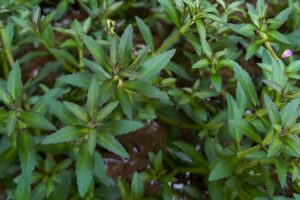
Morphologically, it features thick stems with oval to ovate leaves arranged in opposite pairs along the nodes. The foliage is fleshy and relatively firm compared to many other stem plants. Leaf color typically ranges from bright green to dark green, though it can develop yellowish-green or faint reddish undertones under higher lighting intensities.
A unique characteristic of Bacopa caroliniana is the distinct aroma released when its leaves are crushed, which is commonly described as resembling lemon or mild citrus. This trait is well known among aquascapers and serves as a key identifying feature of the plant.
In aquascaping, it is commonly placed in the midground to background areas because its stems can reach tens of centimeters in height. The upright stem structure and substantial leaf size provide strong textural contrast against fine-leafed species such as Rotala or Myriophyllum. Planting it in groups creates a stable plant mass that delivers clear architectural structure within the layout. It is also exceptionally stable during environmental changes compared to more sensitive stem plants, making it a frequent recommendation for beginners building their first planted tanks.
Care and Requirements
Growth Characteristics
Bacopa caroliniana grows vertically with a sturdy stem structure. Node spacing varies from short to medium depending on light intensity; under low light, internodes stretch and give the plant a sparser look, while higher light levels produce shorter internodes and denser foliage. The plant does not form stolons or runners, growing instead through the extension of its main stem, which can generate lateral branches if the top section is trimmed. Its response to carbon availability is moderate, growing reliably without injected CO₂ while developing tighter, more consistent growth in carbon-supplemented setups.
Lighting
Light requirements fall into the low to medium category, ranging around 30–90 µmol m⁻² s⁻¹ PAR at plant level. Under low light, leaves tend to be dark green, slightly larger, and spaced further apart, though the plant still grows steadily in low-tech systems given stable nutrients and water parameters. Under medium light, growth becomes denser with shorter internodes, and leaf color may shift toward bright green or yellowish hues. High light without balanced nutrients and carbon often causes unstable growth and increases the risk of algae on the broad leaf surfaces.
CO₂ and Carbon
Bacopa caroliniana is adaptive regarding carbon availability, making it a popular choice for low-tech aquariums without CO₂ injection. In high-tech systems with stable CO₂ delivery, growth becomes noticeably more consistent with tighter internodal spacing and active shoot development. This stability helps the plant maintain a compact form when planted in mass groups. Maintaining consistent carbon levels is far more important than achieving high concentrations, as large CO₂ fluctuations can cause uneven growth on new stem sections.
Nutrition
As a stem plant with a moderate growth rate, Bacopa caroliniana requires a balanced supply of macronutrients and micronutrients in the water column. Nitrogen, phosphorus, and potassium support healthy leaf and stem development, with nitrogen deficiency typically manifesting as pale leaves or slowed growth. Micronutrients like iron contribute to brighter foliage under sufficient light. Because its root system is relatively basic compared to rosette plants, most nutrients are absorbed directly from the water column.
Water Parameters
This species is tolerant of broad water parameter variations. Ideal conditions include a pH range of 6.0–7.5 and an optimal temperature between 20–28 °C. Maintaining stable water hardness supports healthy growth, with a general hardness of 3–12 dGH and a carbonate hardness of 1–6 dKH generally causing no issues. Parameter stability is far more critical than targeting specific numbers, as sudden shifts can negatively affect the quality of new growth.
Substrate
Bacopa caroliniana grows well in various aquascaping substrates, including inert substrates like sand or gravel and active soil-based substrates. Its root system is not overly complex, so the primary function of the substrate is anchoring the stem upright. While root activity is slightly more vigorous in nutrient-rich substrates, the plant continues to absorb the majority of its nutrients from the water column. Standard substrate depth in planted tanks is sufficient to anchor the plant.
Propagation
Propagation is accomplished via stem cuttings. Stems that have grown tall can be cut through the middle or top section and replanted directly into the substrate. Under stable conditions, the buried leaf nodes will sprout new roots within a short time. This technique is routinely used in aquascaping to keep plant height proportional while increasing vegetation density within a given area.
Conclusion
Bacopa caroliniana is a hardy, reliable stem plant well-suited for diverse aquascaping environments. With low to medium lighting requirements and the ability to adapt without CO₂ injection, it fits seamlessly into both low-tech and high-tech aquariums. Its upright structure and broad oval leaves offer engaging visual contrast in midground and background placements. Easy propagation via stem cuttings makes it a practical choice for establishing dense foliage masses, offering strong structural value and broad accessibility for aquascapers of all experience levels.