Daftar Isi Show
| Characteristic | Detail |
| Genus | Bacopa |
| Species | Bacopa australis |
| Family | Plantaginaceae |
| Origin | South America |
| Common Name | Bacopa australis |
| Light Requirement | Medium (±50–100 µmol m⁻² s⁻¹ / PAR) |
| Optimal Temperature | 20–28 °C |
| Growth Rate | Moderate to fast |
| Placement | Foreground – Midground |
| Plant Height | ±5–20 cm |
| Ideal pH | 5.5–7.5 |
| Water Hardness | GH 2–10 dGH; KH 1–5 dKH |
| CO₂ Requirement | Adaptive |
| Propagation | Stem cutting |
Additional Information
Bacopa australis is a popular aquatic stem plant in aquascaping due to its compact form and creeping growth habit. This plant originates from shallow water environments across South America, particularly marshes, small streams, and the slow-moving edges of water bodies.
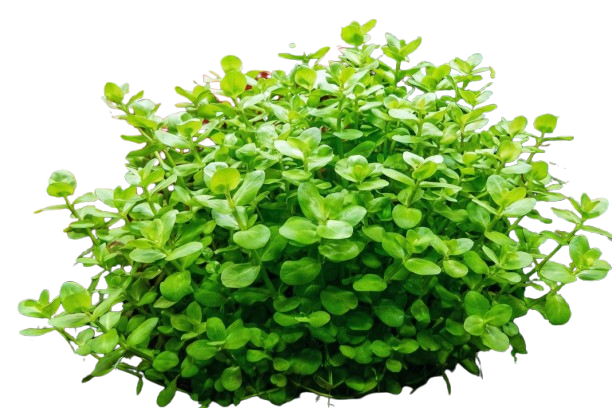
Morphologically, it features soft stems with small, oval to ovate leaves. The leaves grow in opposite pairs along relatively slender stems. Leaf coloration generally ranges from bright green to yellowish-green, depending on light intensity and nutrient availability within the aquarium.
One of the key visual traits that makes Bacopa australis attractive in aquascaping is its ability to form dense bushes with a soft, fine texture. When pruned regularly, it produces compact and tidy clusters, making it a frequent choice for creating seamless, natural transitions between foreground and midground areas.
In aquascape layouts, Bacopa australis is often utilized to provide a soft, low-growing vegetation effect without obstructing hardscape elements. Its small leaves create a lighter visual texture compared to many other stem plants. Consequently, it offers great flexibility across various aquascaping styles, including nature style, Dutch style, and minimalist layouts.
Care and Requirements
Growth Characteristics
Bacopa australis exhibits a stem growth pattern that can develop both vertically and horizontally. Under adequate lighting conditions, it tends to creep along the substrate before sending branches upward. Stems touching the substrate frequently develop adventitious roots at the nodes, allowing the plant to establish dense colonies if left unpruned. Through regular trimming, aquascapers can easily maintain a lower, neater bushy shape. The plant responds clearly to light intensity; under low light, stems stretch with wider internodes, whereas under medium to moderately strong light, growth becomes much more compact with tighter foliage.
Lighting
Light requirements for Bacopa australis fall into the medium category, around 50–100 µmol m⁻² s⁻¹ PAR at plant level. Under low light, the plant can survive, but it typically grows taller with a looser structure, elongated internodes, and fewer lateral branches. Conversely, under medium to near-high lighting, it demonstrates tighter, more compact growth with closer leaf arrangement and more frequent lateral branching, forming a thicker vegetation mass. Consistent lighting is equally important for maintaining a steady plant structure in the aquascape.
CO₂ and Carbon
Bacopa australis is known for being highly adaptive regarding carbon availability. It can grow in low-tech setups without injected CO₂, though its growth rate will be slower and its structure less dense compared to carbon-supplemented systems. In high-tech systems with stable CO₂ injection, the plant exhibits faster growth and increased branching, which helps build a fuller, more aesthetic bush. A steady carbon supply also helps keep the leaves small and proportionally balanced with the stems.
Nutrition
As a stem plant with relatively active growth, Bacopa australis utilizes nutrients from both the water column and the substrate. Balanced macronutrients—nitrogen, phosphorus, and potassium—are vital for supporting healthy leaf and stem tissue development. Micronutrients like iron and manganese are equally important for keeping leaf color vibrant and preventing chlorosis. Nutrient imbalances are typically indicated by slowed growth or reduced leaf size, making a stable nutrient supply far more beneficial than temporary high-dose dosing.
Water Parameters
This species is relatively tolerant of broad water parameters as long as conditions remain stable. Recommended parameters include a pH range of 5.5–7.5 and an optimal temperature between 20–28 °C, which aligns with standard tropical aquarium conditions. At excessively high temperatures, plant metabolism accelerates and growth can become less stable. General hardness levels of 2–10 dGH and carbonate hardness levels of 1–5 dKH provide a comfortable range for this plant. While hard water does not usually cause severe issues, optimal growth is most consistently observed in soft to moderately hard water.
Substrate
Although capable of taking up nutrients directly from the water column, Bacopa australis exhibits more stable performance in a substrate that supports root development. A porous aquascaping substrate helps roots penetrate and establish effectively. Healthy roots enable the plant to form new branches more easily while anchoring creeping stems securely. In many cases, stems creeping along the substrate naturally produce additional roots at nodes, spreading the colony across wider areas.
Propagation
Propagation of Bacopa australis is straightforward and carried out through stem cuttings. Stems that have grown sufficiently long can be cut at a node and replanted directly into the substrate. Within a short time, buried nodes generate new roots and continue growing as independent plants. This technique is routinely employed after trimming to increase bush density while rejuvenating the plant stand.
Conclusion
Bacopa australis is a versatile aquatic stem plant featuring a compact growth habit that is easy to manage. Its small leaves and creeping tendency make it exceptionally well-suited for placement in foreground to midground transition zones. It adapts readily to various aquarium setups, performing reliably in low-tech non-CO₂ aquariums as well as high-tech systems with intensive light and carbon. Given medium lighting and consistent nutrition, Bacopa australis forms a neat, dense green bush that adds fine texture and a natural visual transition to any aquascape composition.