Daftar Isi Show
| Characteristic | Detail |
| Genus | Bacopa |
| Species | Bacopa myriophylloides |
| Family | Plantaginaceae |
| Origin | South America (primarily Brazil and surrounding tropical regions) |
| Common Name | Bacopa Myriophylloides |
| Light Requirement | Medium – High (±70–140 µmol m⁻² s⁻¹ / PAR) |
| Optimal Temperature | 22–28 °C |
| Growth Rate | Moderate to fast |
| Placement | Midground to Background |
| Plant Height | ±15–40 cm |
| Ideal pH | 5.5–7.2 |
| Water Hardness | GH 2–8 dGH; KH 0–4 dKH |
| CO₂ Requirement | Medium – High |
| Propagation | Stem cutting |
Additional Information
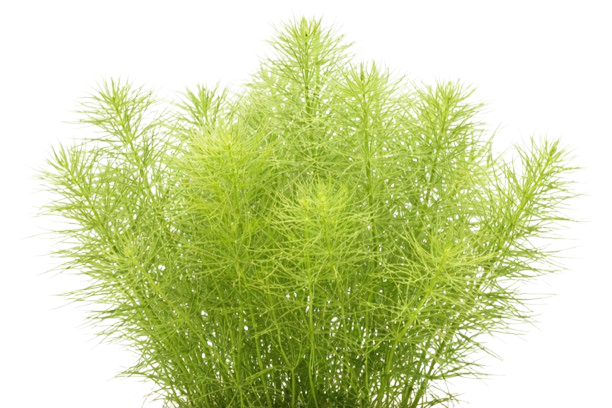
Bacopa myriophylloides is an aquascaping plant with a highly unique morphology within the genus Bacopa. Unlike most Bacopa species that feature broad, fleshy leaves, this species possesses an extremely fine, thin, and branched leaf structure resembling plants from the genus Myriophyllum. This visual similarity to filamentous aquatic plants is the origin of its species name.
Its stem grows upright, developing relatively short internodes under adequate lighting. Each node produces delicate, hair-like branched leaves that form a structure reminiscent of a small fan. When planted in groups, it creates a light, translucent, and soft-textured mass of vegetation within the aquascape.
In aquascape layout design, Bacopa myriophylloides is typically utilized as a midground or light background plant. Its fine leaf structure provides an engaging contrast when positioned near broad-leafed plants such as Anubias, Cryptocoryne, or certain Echinodorus species. Aquascapers frequently leverage this textural contrast to create visual depth and structural variation within the composition.
In its natural habitat, this plant is generally found in shallow, quiet waters such as marshes, natural canals, or slow-moving riverbanks across tropical South America. These environments typically feature soft, organic-rich sediments and receive ample sunlight throughout the day. This natural background explains why the plant performs best in aquascape systems with medium to high lighting.
Beyond its aesthetic value, Bacopa myriophylloides adds dynamic movement to the layout. The gentle swaying of its delicate leaves in the water current provides a natural effect that enhances the sense of life in the background of the aquarium.
Care and Requirements
Growth Characteristics
Bacopa myriophylloides is a vertically growing stem plant. The stem continues to elongate toward the water surface as long as light and nutrient conditions are sufficient. When planted in groups, new stems emerge from lower nodes following a trim, developing into an increasingly dense bush.
This plant is quite responsive to light intensity and carbon availability. Under high lighting with stable CO₂, growth can become fairly rapid with tight internodal spacing. Conversely, under low light, internodes tend to stretch and the overall plant structure becomes less dense.
Lighting
- Category: Medium – High (±70–140 µmol m⁻² s⁻¹ / PAR)
Under adequate light intensity, foliage grows denser and branching becomes tighter, forming a compact plant mass. Strong lighting also helps maintain its fine, symmetrical leaf structure.
If lighting is too low, the plant can survive, but the stem structure tends to elongate with wider internodes. This gives the plant a sparse appearance, reducing its aesthetic value within the layout.
CO₂ and Carbon
While this plant can adapt to non-CO₂ injected systems, its performance is typically non-optimal. In low-tech setups, growth tends to be slower and the structure remains less dense.
In high-tech systems with a stable supply of injected CO₂, Bacopa myriophylloides demonstrates significantly healthier growth. The foliage becomes lush, branching increases, and the overall plant appears more compact. Consequently, its carbon requirement is generally categorized as medium to high for achieving ideal form.
Nutrition
As a stem plant with a moderate to fast growth rate, Bacopa myriophylloides requires a balanced supply of nutrients in the water column.
Macronutrients such as nitrogen, phosphorus, and potassium play a vital role in supporting new tissue development. Meanwhile, micronutrients like iron and manganese help maintain bright green leaf coloration and support metabolic functions.
Nutrient imbalances can directly affect the plant’s form, manifesting as slowed growth, pale foliage, or reduced branching.
Water Parameters
This species is relatively flexible regarding water parameters, provided conditions remain stable.
Recommended parameters:
- pH: 5.5–7.2
- Temperature: 22–28 °C
- GH: 2–8 dGH
- KH: 0–4 dKH
Soft to moderately hard water provides more stable growth conditions. Parameter stability is far more important than frequent adjustments to chase exact target numbers.
Substrate
As a stem plant, Bacopa myriophylloides does not rely entirely on substrate nutrients, as a significant portion of its uptake occurs through the water column.
However, a stable substrate aids the initial rooting process post-planting. Porous aquascaping substrates capable of binding nutrients help the plant adapt more quickly. The root system is relatively fine and serves primarily to anchor the stem within the substrate.
Propagation
Propagation is performed via stem cuttings, the standard method for aquatic stem plants.
Tall stems can be cut and replanted directly into the substrate. The severed stem section will typically develop new roots within a few days if environmental conditions are stable.
Meanwhile, the remaining stem portion in the substrate often produces lateral shoots from its lower nodes, naturally forming a denser cluster over time.
Conclusion
Bacopa myriophylloides is an aquascaping plant with a distinct morphological character that sets it apart from most Bacopa species. Its extremely fine, branched leaves create a light, delicate visual texture within aquarium layouts.
This species is best suited for placement in midground to background areas, particularly for providing textural contrast against larger-leafed plants. Under medium to high lighting with a stable CO₂ supply, it grows rapidly and forms dense clusters.
Overall, Bacopa myriophylloides reaches its full potential in high-tech aquascapes, though it can still be maintained in low-tech setups with slower growth. With adequate lighting, balanced nutrition, and stable water parameters, it serves as a unique and highly valued aesthetic element in aquascape compositions.