Daftar Isi Show
| Characteristics | Detail |
|---|---|
| Genus | Hygrophila |
| Species | Hygrophila balsamica |
| Family | Acanthaceae |
| Origin | India, Sri Lanka |
| Common Name | — |
| Light Requirement | Medium–high (±35–90 µmol m⁻² s⁻¹ / PAR) |
| Optimal Temperature | 24–28 °C (tolerance 18–30 °C) |
| Growth Rate | Fast |
| Placement | Midground – Background |
| Plant Height | 15–20 cm |
| Ideal pH | 5.0–7.0 |
| Water Hardness | GH 3–10 dGH; KH 2–12 dKH |
| CO₂ Requirement | High |
| Propagation Method | Stem cuttings |
Additional Information
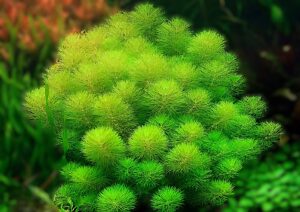
Hygrophila balsamica is a stem plant with an upright and relatively strong structure, featuring bright green leaves that are finely divided and delicate. Young leaves appear light green to yellowish with a soft, feathery texture, resembling a finer version of Hygrophila difformis. Under high light and sufficient CO₂ supply, the plant exhibits a vivid green coloration that enhances its visual impact.
This species grows rapidly and requires regular trimming to maintain a compact form. After cutting the stem tips, lateral shoots develop quickly, forming dense clusters. Under low light and limited CO₂ conditions, leaves tend to become smaller, coarser in texture, and paler in color.
Native to tropical wetlands in South Asia, particularly India and Sri Lanka, this plant naturally occurs in swampy environments. In aquascaping, Hygrophila balsamica is typically used as a background plant to provide a bright green accent. Its fine leaf structure and vivid coloration create strong contrast when placed alongside darker plants or substrates, contributing to a more dynamic composition.
Requirements and Care
Growth Characteristics
Hygrophila balsamica grows vertically as a primary stem plant capable of producing numerous lateral shoots. When the top is trimmed, side shoots develop rapidly, allowing the plant to form dense, bushy growth. Its growth rate is very fast, making regular trimming essential to prevent it from overtaking the layout.
Under low light and limited CO₂, leaf size decreases and coloration becomes duller. In optimal conditions, leaves grow larger and display a bright green tone with a softer, more refined structure.
Light
The light requirement falls within the medium to high category, with an approximate PAR range of 35–90 µmol m⁻² s⁻¹.
Stronger lighting is important for achieving bright green coloration and optimal growth. Under low light conditions, leaves become smaller, less dense, and visually less striking. In contrast, under higher light intensity combined with adequate CO₂, the plant develops dense foliage and a more vibrant appearance.
CO₂ and Carbon
Hygrophila balsamica has a high demand for CO₂ to achieve optimal growth. It is best suited for high-tech systems with CO₂ injection, where sufficient carbon availability promotes faster growth and brighter leaf coloration.
Without adequate CO₂, growth slows down and the plant may appear less vibrant. In practical aquascaping, maintaining stable CO₂ levels (commonly around ±20–30 mg/L) significantly improves plant performance. Consistency is more critical than peak concentration.
Nutrients
This plant is considered a heavy feeder, requiring a consistent supply of both macronutrients and micronutrients.
Macronutrients such as nitrogen (N), phosphate (P), and potassium (K) are essential for supporting rapid stem and leaf development. Micronutrients, particularly iron (Fe), play a crucial role in maintaining bright green coloration. Iron deficiency may result in pale or yellowish new growth.
The plant benefits from both water column fertilization and nutrient-rich substrates, as it is capable of absorbing nutrients through both pathways. Balanced nutrient availability is key to maintaining stable growth.
Water Parameters
Stable water conditions are essential for consistent growth. The ideal pH range is slightly acidic to neutral, around 5.0–7.0.
The optimal temperature range is 24–28 °C, with tolerance between 18–30 °C. Moderate water hardness is suitable, with GH ranging from 3–10 dGH and KH from 2–12 dKH.
Avoiding extreme fluctuations in water parameters is important, as instability may negatively affect plant health and growth performance.
Substrate
Hygrophila balsamica performs best in nutrient-rich substrates. The use of aquasoil or other enriched substrates is highly recommended to support strong root development and sustained growth.
Although it can absorb nutrients from the water column, a nutrient-dense substrate significantly enhances early establishment and long-term stability. The root system, while not extremely complex, benefits from fine-grained substrates that allow proper anchorage and nutrient access.
Propagation
Propagation is most effectively carried out through stem cuttings. Sections of the stem can be cut and replanted directly into the substrate, where they will quickly develop roots and continue growing.
For optimal results, cuttings should be taken below a node or lateral shoot. It is important to note that emersed-grown specimens may produce sap that is potentially harmful. Therefore, such cuttings should be fully submerged and allowed to transition into submerged growth before being introduced into an aquarium environment.
Conclusion
Hygrophila balsamica is a visually striking aquascape plant with bright green, finely textured foliage that is particularly effective as a background element. Under strong lighting and adequate CO₂ supply, it develops dense growth and vibrant coloration.
Due to its fast growth rate and relatively high nutrient demand, this plant is better suited for stable high-tech systems. However, its strong response to trimming and ability to form dense clusters make it an effective filler plant within aquascape layouts.
With proper maintenance, including stable water parameters, balanced nutrition, and regular trimming, Hygrophila balsamica offers both aesthetic value and functional versatility as a dynamic green accent in planted aquariums.