Daftar Isi Show
| Characteristics | Details |
|---|---|
| Genus | Myriophyllum |
| Species | Myriophyllum simulans |
| Family | Haloragaceae |
| Origin | Eastern Australia |
| Common Name | Amphibious Water Milfoil |
| Lighting Requirements | Medium to high (±70–140 µmol m⁻² s⁻¹ PAR) |
| Optimal Temperature | 20–28°C |
| Growth Rate | Fast |
| Placement | Background to midground |
| Plant Height | 30–60 cm |
| Ideal pH | 5.0–7.5 |
| Water Hardness | GH 3–10 dGH; KH 2–8 dKH |
| CO₂ Requirement | Medium to high |
| Propagation | Stem cuttings |
Additional Information
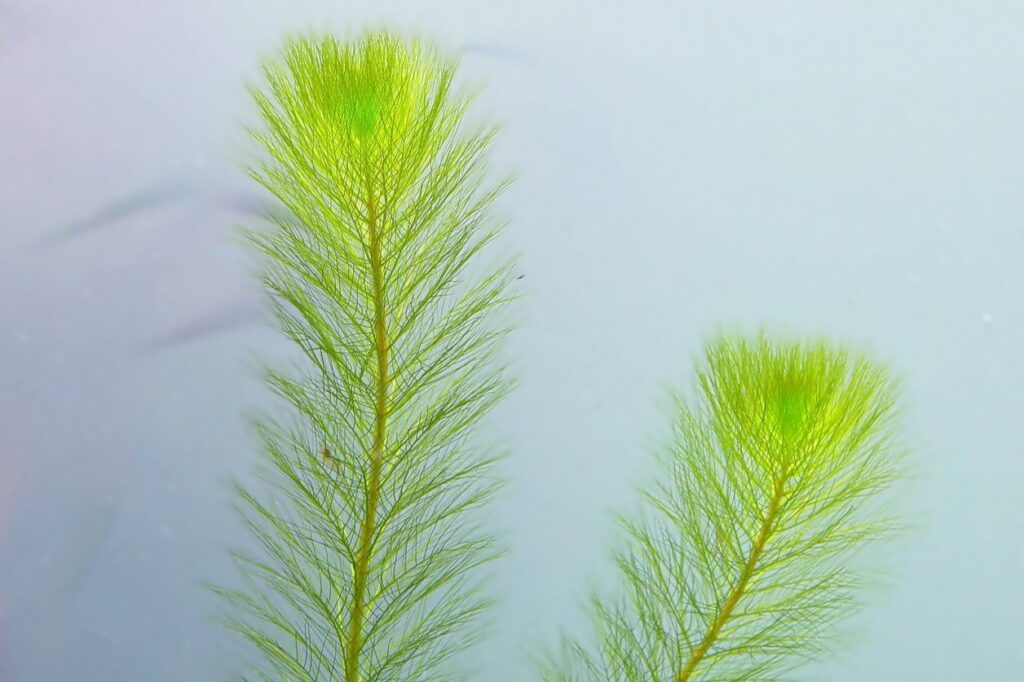
Myriophyllum simulans is a fine-leaved stem plant characterized by densely arranged pinnate leaf structures, creating a light, feathery texture typical of the genus. In its submerged form, the leaves display a bright green coloration with extremely thin, filament-like segments, producing a sense of transparency and visual depth within an aquascape.
In its natural habitat in eastern Australia, this species is more commonly found in its emersed form, growing in marshes or along shallow water margins. This adaptation allows it to tolerate fluctuating water levels. However, in aquarium conditions, the submerged form is far more dominant and aesthetically desirable.
In aquascape layouts, Myriophyllum simulans is typically used as a background plant to create a light and dynamic green mass. In larger tanks, it can also function effectively in the midground, providing a smooth textural transition between broad-leaved plants and carpeting species.
Requirements and Care
Growth Characteristics
This species grows vertically with a main stem that is relatively flexible yet sturdier than many other Myriophyllum species. It exhibits a fast growth rate and readily produces lateral shoots after trimming, making it highly responsive to pruning techniques.
Internodal spacing tends to elongate under unstable lighting or CO₂ conditions. Under optimal parameters, growth becomes more compact and dense, forming a bushy structure.
Lighting
Lighting requirements range from medium to high, approximately 70–140 µmol m⁻² s⁻¹ PAR. Under low light conditions, the plant can survive but will exhibit elongated internodes and reduced leaf density.
With higher light intensity, the plant develops tighter leaf structures, brighter green coloration, and significantly increased density. Consistent lighting is critical to maintain a compact form and prevent uncontrolled growth.
CO₂ and Carbon
Myriophyllum simulans can survive in non-CO₂ systems, but its performance declines, particularly in terms of density and growth rate.
In high-tech systems with stable CO₂ injection (around 20–30 ppm), the plant reaches optimal performance, producing finer and more compact foliage. CO₂ fluctuations may lead to distorted shoot tips and reduced visual quality.
Nutrients
As a fast-growing species, its nutrient demand is relatively high. Uptake of macronutrients such as nitrogen, phosphate, and potassium is significant, making consistent nutrient availability essential.
Micronutrients, particularly iron, play an important role in maintaining vibrant green coloration and overall leaf health. Nutrient imbalances may result in unstable growth or increase the risk of algae developing on the plant’s delicate leaf structures.
Water Parameters
This plant thrives in slightly acidic to neutral water (pH 5.0–7.5) with temperatures ranging from 20–28°C. Water hardness should be kept in the low to moderate range, ideally GH 3–10 dGH and KH 2–8 dKH.
Stability of water parameters is more critical than absolute values. Sudden fluctuations can induce plant stress, especially during the initial adaptation phase.
Substrate
Although capable of absorbing nutrients from the water column, the use of a nutrient-rich substrate improves growth stability, particularly during the early planting stage.
The root system develops well in active substrates, helping the plant maintain an upright structure and supporting stronger stem development.
Propagation
Propagation is performed through stem cuttings. The trimmed tops can be replanted directly into the substrate and will quickly develop new roots.
Regular trimming not only controls shape but also stimulates lateral shoot formation, resulting in a denser and bushier appearance.
Conclusion
Myriophyllum simulans is a fast-growing aquascape plant with fine-textured foliage that is highly effective for creating visual depth and contrast within a layout. It is best suited for medium to high-tech systems, where stable lighting, CO₂, and nutrient levels can support optimal performance.
In aquascaping, its role as a background or midground plant is particularly strong, especially for building a light yet dense plant mass. With proper care, it serves as a consistent and aesthetically pleasing structural element across various aquascape styles.